(This might sound abstract. Please bear with me. I promise it's super easy to understand (don't click on the links if you don't feel ready :) - This is the intro to people that might think that talking about the nature of reality is "complicated" or "nor worth their time"; it is not complicated..., it is as easy as buying a loaf of bread).
Please bear with me.
## A big deal
I would be making a disservice if today I didn't write about our latest experiment where [daily variations of the amplitude of the fringe shifts (were) observed when an air-glass Mach-Zehnder type interferometer is rotated](https://www.researchgate.net/publication/369529273_Daily_variations_of_the_amplitude_of_the_fringe_shifts_observed_when_an_air-glass_Mach-Zehnder_type_interferometer_is_rotated).
In my opinion, this is a big deal and please let me explain why:
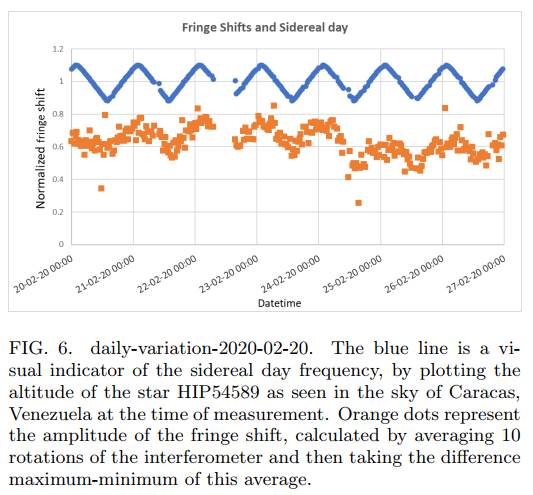
*[Plot of the daily variations measured](https://siran.github.io/assets/writing/daily-variations.png)*
## What does this mean
Put simply, I haven't been able to find any current-physics explanation for:
1. fringe shifts upon rotation in a fixed in-lab interferometer that slowly rotates,
2. daily, periodic variation of the amplitude of such fringe shifts
## What could it be
My current explanation is that we are measuring a Doppler frequency shift while we move relative to the medium that propagates light.
I haven't yet made the mathematical fit to the data in [Matlab](https://matlab.mathworks.com/) (I've been fixing this blog so I could write), but it seems to me that a Doppler fit to the data is much more appropriate than any dragging effect.
---
I have a couple of explanations. So stay tuned.
---
- [Preferred Frame Writing on GitHub.com](https://github.com/siran/writing)
(built: 2026-06-30 19:33 EDT UTC-4)