How One Mysterious “Node” Might Explain Space, Time, and Everything Else
How One “Node” Might Explain Space, Time, and Everything Else
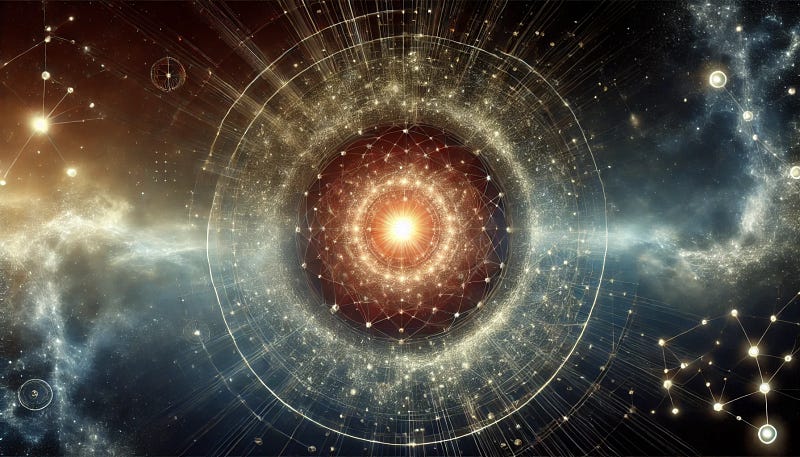
TL;DR:
A stable node with an uncomputable inner structure. Composed by subnodes that interact with each other in cause→effect sequences — this becomes “time.” Counting the steps defines “distance.” Loops of these interactions become “clocks.” No outside space or energy needed. It’s all contained in that single node.
In this framework, all of reality emerges from a single, stable Node that ever changes in total energy. The Node’s inner structure is uncomputable, with countless “subnodes” with internal interactions. These subnodes form cause-effect relationships, which define a partial order: a cause always precedes its effect. This ordering gives rise to the concept of “time.” By repeatedly looping a cause-effect chain back to its origin, one can build a clock that measures intervals through the number of cause-effect steps.
(all my stories can be read for free. if you’re not a subscriber, you can read the story following this link.)
Moreover, “distance” is determined by counting how many causal steps are needed for one subnode to affect another. If a message (or signal) travels directly between two subnodes in a single step, they are “close”; if it must pass through many intermediaries, they are “farther apart.” The originating subnode can also measure distance by observing its own state change after a full round-trip chain, creating a self-referential metric.
Ultimately, this model offers a shift from typical assumptions: space and time aren’t imposed from the outside but instead arise from chains of cause and effect within a single Node with uncomputable internal structure. The Node’s energy never changes — it’s stable, yet its internal interactions give birth to the measurable phenomena of time (ordering) and space (distances), providing a fresh lens on how reality might be structured at the most fundamental level.
Introduction
Imagine starting with a single “something” that barely even qualifies as a thing — no size, no shape, no well-defined energy. It’s more like an abstract concept: a Node with an unfathomable internal complexity. In everyday life, we take space and time for granted. But what if these basic concepts emerged out of simple cause-and-effect relationships inside this single Node?
1. The Node: A Quiet Powerhouse
A Stable Foundation
This Node — call it N — doesn’t change overall. It’s “stable” in the sense that whatever total amount of energy or information it has just stays constant. We’re not talking about a tangible object like an atom or a sphere floating in space; there’s no space or time yet! It’s just a framework: think of it like the entire canvas before you paint anything on it.
Incomputable Complexity
Inside N, you can imagine countless “subnodes” (or microstructures). They’re all connected in ways too complex to write down in normal mathematical formulas. We label it “uncomputable” to say: It’s deeper than any standard equation can fully capture.
2. Cause and Effect: Where “Time” Is Born
No Clocks? No Problem!
If there’s no time, how do things happen? Inside N, each subnode can interact or affect another subnode. We don’t need a timeline; we just need a logical order: cause→effect.
- Cause: Subnode A triggers something.
- Effect: Subnode B responds.
That’s it. These cause-effect relationships create a partial order — meaning sometimes A causes B, but B might not cause A back. This ordering is our first hint of time.
Why This Feels Like “Time”
Think of your daily life: you do something (cause), and something else happens (effect). We say the first thing occurred before the second. That “before-after” concept is how we experience time. In our Node-based universe, “before” and “after” are simply a path of influence from one subnode to another.
3. Distance: Counting Steps of Influence
One Step, One Unit
How does the concept of space arise? We say two subnodes are “close” if a single nudge from one to the other happens in just one causal hop. If subnode A needs to pass the message through C, D, E, and so on before reaching B, they’re effectively farther apart. The more steps in the chain, the greater the “distance.”
Longer Chains, Greater Distance
In standard physics, we measure distance with rulers or by timing how long it takes light to travel. Here, distance is purely how many cause-effect events must happen in sequence from one subnode to another.
4. Building a Clock from Loops
Clocks Without Gears
In everyday life, a clock ticks because gears turn or crystals vibrate in a predictable cycle. In the Node realm, we can have a subnode A send a nudge that eventually comes back to A — maybe it bounces through various subnodes and returns with a big “Hello!” The cycle repeats again and again.
- Emit a nudge (cause).
- Observe the effect returning.
- Count how many cause-effect steps were involved.
Each repeated cycle is like a tick of a clock. Ta-da! We’ve created a measure of time from pure cause-and-effect loops, no physical gears needed.
5. A Universe from a Single Node?
Stable Overall, Dynamic Internally
It might sound contradictory: How can something be stable and dynamic at the same time? The Node, as a whole, doesn’t gain or lose resources, but inside, it’s a buzz of interactions. Think of it like a perfectly sealed jar: the total amount of air never changes, but air molecules inside can jostle around. It’s the jostling — the cause-effect patterns — that might create an illusion of flow (time) and separation (distance).
From Abstraction to (Possible) Reality
Physicists often talk about “signal-based definitions” of distance and time: you send a light beam from point A to point B, measure how long it takes, and call it a certain distance. Our Node idea just takes that principle to the extreme, saying everything is defined by signals, cause, and effect.
6. Questions for the Curious
- What about Mass, Energy, or Gravity?
Those might be emergent properties, too. If certain patterns of cause-effect become stable or repetitive, we can interpret them as “mass,” “fields,” or other familiar physics terms. - Is This Testable?
It’s deeply theoretical. However, many big breakthroughs (like quantum mechanics or general relativity) started as abstract frameworks. Whether it can match real data depends on whether we can map its subnode interactions to known forces and particles. - Does This Solve Everything?
Not immediately. It’s a new lens to see how space and time might be products of something more fundamental. That said, it doesn’t instantly rewrite physics books — it proposes a fresh conceptual ground floor.
7. Why This Is Exciting
- Minimal Starting Point: From almost “nothing,” we get cause-effect. From cause-effect, we get time. From repeated cause-effects, we get clocks. From chain lengths, we get distance.
- Boundless Possibility: Because the Node is incomputably complex, it can host a vast range of phenomena. This means it’s theoretically open-ended enough to encompass the weirdness we observe in reality.
- Connects to Existing Physical Ideas: Philosophically, many scientists think of time and space as not fundamental, but emergent from deeper principles. This Node concept is a neat, straightforward example.
Conclusion
We’ve toured a world where one stable Node — seemingly unchanging from the outside — secretly bursts with infinite cause-effect relationships, birthing an emergent tapestry of “time” and “distance.” It’s a compelling illustration that challenges our usual assumptions, letting us consider that maybe the space around us and the clock on the wall are not primal givens but rather manifestations of deeper, more abstract processes.
This isn’t just high-level speculation. It aligns with the operational ways we measure reality: sending signals, receiving them, and inferring structure from their journeys. Who knows? Future theories might reveal how the entire cosmos emerges from something even simpler than a Node — and we might recognize these intangible cause-effect patterns in a new light.
Whether or not this concept becomes the next major scientific revolution, it brings a fresh perspective: sometimes, stepping back to near-emptiness and focusing on how things affect each other can open the door to understanding all the complexities we see as “space,” “time,” and ultimately, reality itself.