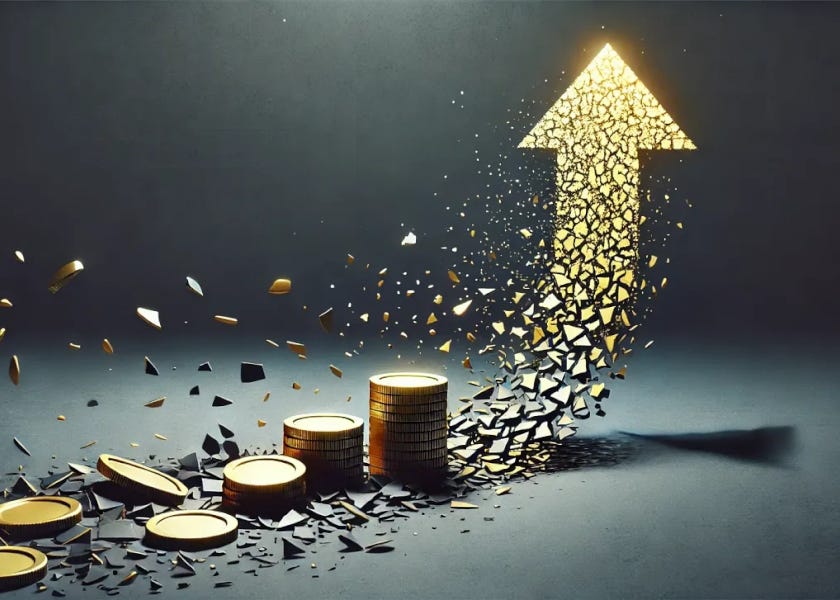
Selling means ending up having fewer shares; that is, lower growth rate—aka weaker compounding growth.
Selling creates cognitive dissonance: Why sell if the company is doing well?
You can stay invested while maintaining liquidity.
At current rates, you’re basically being paid to acquire good debt.
Selling incurs taxes (~0–20% for long-term, higher for short-term).
Selling leaves you exposed to by-design inflation and depreciation of currency.
e.g., S&P 500 has consistently grown handsomely for buy-and-holders over past 5-10 years; and you can still remain liquid and access your money when you need it.
Bad debt (e.g., credit cards) is bad because they ask more than what the market can give, so you end up working up the difference.
Selling just to take profits unnecessarily increases volatility.
Ok, when you have or just want to sell: the correct interpretation of "Selling is for Losers."
When I started investing, I didn’t know how to “take profits” from the growth of my investments without selling. Selling meant having fewer shares. And fewer shares clearly meant slower growth—lower growth rate, weaker compounding, and a direct hit to my long-term gains.
Selling creates cognitive dissonance for everyone involved: “Why are the shareholders selling if the company is doing great?” It sends the wrong message to the markets, the CEO, and even to yourself and me. This lack of alignment undermines confidence, creates unnecessary volatility (especially when you sell just to take profits), and risk distracting leadership from continuing good decisions.
The alternative to selling is simple: stay invested and remain liquid.
Debt with an interest rate far lower than the appreciation of assets like the S&P 500 makes this possible. At current rates, you’re basically being paid 6-10% of the “good” debt you acquire.
You remain free to spend on yourself instead of funding the government.
Funding the government and shaping society to our liking is still accomplished by leveraging your spending—through sales taxes, tips, keeping investments, etc. Your choices tell society what’s needed, creating a positive feedback loop.
By not selling, you keep your portfolio growing uninterrupted while staying liquid and shaping society to your liking.
You can alwys access your money any time you need it, for any purpose you choose.
Bad debt (like credit cards) is bad because they ask more than what the market can give, so you end up working up the difference.
When the interest rate is higher than market returns, it forces you to work up the missing money.
That is also why paying off bad debt is paramount for financial health.
Selling also has costs—namely taxes. Using the U.S. as a proxy for the world, capital gains taxes range between 0% and roughly 20% for long-term holders, and can be much higher for short-term traders (day traders).
The funds you don’t sell keep compounding for you.
Selling leaves you unhedged against the steady depreciation of currency. The depreciation of (all) currency is by design. Let me repeat:
The depreciation of (all) currency is by design.
The U.S. dollar loses about 3% of its value a year to encourage spending over hoarding.
Some, like my friend, literally pay fees to keep money in the bank—like a negative interest account.
It’s a situation that makes me laugh every time I think of it, but it’s also very serious. Unbiased financial education is needed among most. Some people dont even invest, making them extra-losers! But that is beyond the point of this article.

The S&P 500 (the five-hundred biggest companies in the US, lead by the “great 7”, that is Apple, Microsoft, Google parent Alphabet, Amazon.com, Nvidia, Meta Platforms and Tesla), has consistently rewarded buy-and-holders, returning handsome gains over the past 5–10 years and beyond.
SPY (the ETF that follows the S&P 500, which is the one you can buy) has never decreased by more than 40%. If you simply don’t sell and wait, there’s little reason to believe it will go negative long-term. Of course, a black swan event can happen, but if that occurs, you’d likely have far bigger concerns than a dip in your portfolio.
At some point, we all need cash for one reason or another, and borrowing might not be an option—or at least not in some hypothetical scenario. “Selling is for losers” also means that if you’re forced to sell, sell the loser assets, not the winners. Tax-loss harvest and carry the loss forward whenever possible.
I still get burned sometimes while making toaster oven pizzas or lighting a candle, and it is OK. It’s part of doing business, if you know what I mean.
What do you think? Please share your thoughts.
Selling is for losers—of wealth, time, and opportunities.
Disclaimer:
This article is for informational purposes only and does not constitute financial, investment, or legal advice. Past performance is not indicative of future results. Always consult with a qualified professional before making financial decisions, and never invest more than you can afford to lose.