
Escaping the belief that we need money
There is no doubt that money is a source of concern for many people. Today’s popular culture is filled with references on how to succeed, how to get what you want, and how to achieve your dreams. Each of these goals seems to require money as a means to fulfill our deepest desires. The pursuit of money has made it evident that money has become an end rather than a means. We tend to forget about the experience we want to get and focus solely on money as the goal. Money thus becomes an idol or a god in itself.
When money becomes an end in itself, it also becomes a source of problems on its own. For example, it is well known that one of the main causes of relationship breakups nowadays is money. Families disintegrate over old grudges related to money, and even entire countries go to war over economic issues.
People with spiritual inclinations and students of A Course in Miracles are not exempt from this problem either. Many of us have completely or partially escaped the temptation to see money as an objective in itself. However, very few of us have escaped the belief that obtaining money is necessary to satisfy our needs and desires in this world. Some think that if they devote themselves to the spiritual path, they will live a life of poverty.
I have also met many people who wanted to dedicate their lives to God, run workshops, or offer psychotherapy, but they constantly find themselves limited by financial capacity or concerns. From a broader perspective, each of us has become dependent on money. Without it, we cannot live or thrive.
In the world of spirituality, there seems to be two main points of view regarding money. The first view, perhaps the oldest of the two, tells us that money is an evil force. In the Bible, for example, we find a passage that says that the love of money is the root of all evil. There is also the famous saying of Jesus that it is easier for a camel to pass through the eye of a needle than for a rich man to enter the kingdom of heaven.

On the other hand, there is a very popular view today that assures us that money is inherently good. According to this view, our goal is to have money and to live abundantly. God wants you to have everything you desire. Your abundance and the world you manifest are reflections of your alignment with God and His will. The topic of manifestation is very fashionable today, and books like “The Secret” teach us how to find God’s will and attain everything we want in this world.

As students of A Course in Miracles, we should have total clarity on this topic if we truly seek peace in our lives and aim to bring peace to the world as well. What does the Course say about this issue? How can we completely escape the illusion of money and the hold it has over our lives? How can we get what we truly want?
The topic of money is intrinsically tied to the topic of needs. We can hardly talk about money without referring to the needs we are meaning to fulfill through it. So, before understanding how the illusion of money took hold, we need to understand what the Course teaches about needs. This will be our focus in the coming days.

In the coming posts, we will give an honest look to the topic of needs and how we attempt to satisfy them.
At the same time we give it an honest look, we will also be applying correctives to undo our current vision of money. This way our mind will be more open and willing to accept an entirely new vision.

As alluded to in the introduction, we must be crystal-clear on the topic of needs before we can safely dive into the topic of money. After all, we use money mostly to satisfy certain needs or wants. So, what has A Course in Miracles to say about the needs we have?
The first thing to understand about needs is the picture the Course paints about our reality in Heaven. The Course describes Heaven not as a place but as a state of mind in which there is a complete absence of needs. We find this idea, for example, in Chapter 13:
Your Father knoweth that you have need of nothing. In Heaven this is so, for what could you need in eternity? (CE T-13.VIII.1:1-2)
I’m not going to spend much time explaining why in Heaven we have no needs. We are just taking Jesus at his word that this is so. Simply, God willed for us to live with no needs whatsoever. In Heaven, we had no need for anything. However, upon coming to this world, we placed ourselves in a situation where needs became a thing:
In your world you do need things, because it is a world of scarcity, in which you find yourself because you are lacking. (CE T-13.VIII.1:3)
How did this happen? How did we become this needy beings that spend their lives in want? What is truly behind each of our needs? Well, if we examine the concept of need, we discover that every need involves, by definition, a lack. A lack can be understood as a void of something. That void must be filled by that very thing which is missing. So, needing “something” is the same as wanting to fill the void of that very thing.
A need implies lack by definition. It involves the recognition (…) that you would be better off in a state which is somehow different from the one you are in. (CE T-1.48.20:1-2)
So, Heaven, which is a state where we had no needs, was by definition a place with no lack. Since we had no lack, we did not have any notion of a possibility of being better off. How did that change?
Until the separation (…), nothing was lacking. This meant that you had no needs at all. If you had not deprived yourself, you would never have experienced them. (CE T-1.48.20:3-5)
At some point, we decided to separate from God. This was more of a desire than an actual thing. After all, God is part of everything there is, so it must be impossible to separate from him. What we did, instead, was to imagine that we did. To take a part of ourselves out, so we could be apart from everything else. We imagined that we took God out from the core of our being. For the first time, we had the experience of being deprived of something we used to have. By separating from God and coming to this world, we discovered what it meant to be without God. The separation led us to experience our first lack—the lack of God Himself.
As we said before, having needs involves recognizing that you could be in a better state than you are now. That is, every need is simply a motivation. A need represents the motivation to fulfill a specific lack. The void of God at the core of our being not only became our first experience of lack, it also caused the idea of behavior. Without needs, there would not be a need for behavior at all:
After the separation, needs became the most powerful source of motivation for human action. All behavior is essentially motivated by needs, but behavior itself is not a divine attribute. (CE T-1.48.20-21)
Again, in Heaven, where there is no lack, behavior was unnecessary because there was no motivation for change. In this world, however, any behavior we exhibit or see in others is motivated by certain specific needs. Heaven is also a place where only spirit exists. Unlike this world, it is a place without forms or physical things, as the Course explains. It is a place that exists within the Mind of God. In a place without needs, there was no need for anything to express our behaviour with, as behavior is just motivation to fulfill our needs.
Once we separated, we were also in need of a thing with which we could express any behavior. Something tangible and could take us from one place to another and witch wich we could experience the effect of change itself. That thing is the body. The body is the mechanism through wich we express our behavior:
The body is the mechanism for behavior. Nobody would bother even to get up and go from one place to another if he did not think he would somehow be better off. (CE T-1.48.21:3-4)
However, as we explained above, the body originally arose as a product of our the desire to separate from God. This desire required a symbol to keep us separate from our Creator. Therefore, the body is also the symbol of the separation from God. You can think of the body as some sort of protective barrier that keeps us separated from the rest of the world. This protective barrier is what proves to us every day that “I am me” and that I cannot be anything else.
Like any symbol, the body can change its purpose and be used for something positive. When the body is used to separate, it seems that the body has its own needs. When we use the body to keep ourselves separated from God, we become slaves to those needs and will spend our lives satisfying them. On the other hand, if we made God our only need, then our behavior, expressed through the body, would reflect that motivation too. Believing that we can be better off is, therefore, a good thing. It is what ultimately motivates us to satisfy the need for God, our only real need.
So, the fact that behavior is not a divine attribute does not mean that behavior, or the body, is something bad in themselves. Now that we have invented the concept of behariour, then it becomes the best mechanism we have at our disposal to act on our desire to heal our lack:
Believing that you could be “better off” is the reason why you have the mechanism for behavior at your disposal. That is why the Bible says, “By their deeds ye shall know them.” (CE T-1.48.21:5-6)
Behavior must be expressed through the body, so we need to use it as a way to be “better off”. But, since behavior is just a reflection of some internal motivation or need, then the body must reflect that internal motivation too in its actions. In other words, given the needs of any person, then their behavior will follow, for all behavior is a way to satisfy some need. And given their motivation, their deeds will follow. This is why “By their deeds ye shall know them.” A person whose motivation is to reach God will exhibit a behavior that is in accordance with this desire.
Yet, the majority of us here use or bodies and behavior not to seek God, but to keep the separation going. As we do that, it seems like like there are hundreds of different needs to satisfy, each one more important than the other. There are so many and some seem so important and unavoidable, that it seems naïve to think that we can seek God with our behaviour before fulfilling those other needs before.
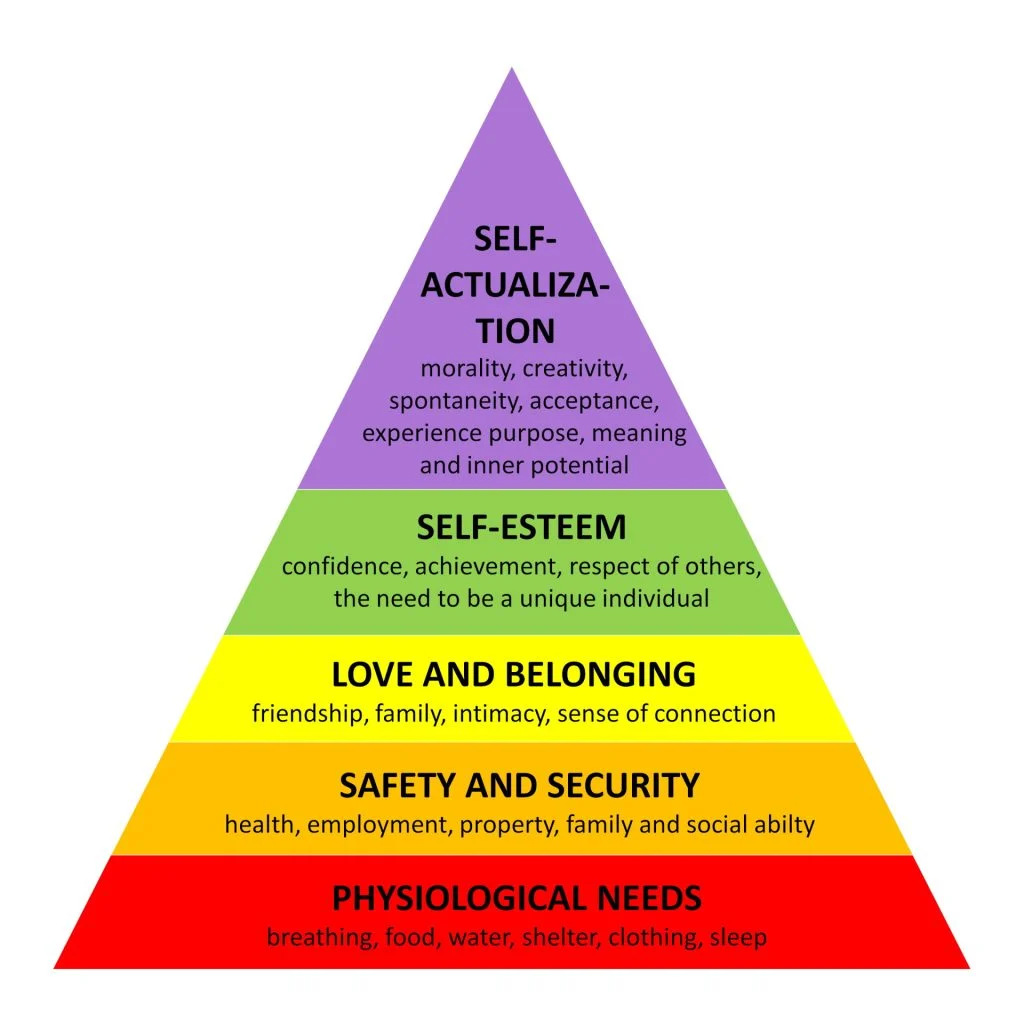
Maslow’s famous hierarchy of needs is a great example of this idea. The chart above is commonly understood to say that we must first satisfy our physiological and safety needs before satisfying the need for relationships and spiritual fulfillment. However, Jesus tells us that this understanding is completely wrong:
You act according to the particular hierarchy of needs you establish for yourself. Your hierarchy, in turn, depends on your perception of what you are; that is, what you lack. This establishes your own rules for what you need to know. Separation from God is the only lack you really need to correct. But your separation would never have occurred if you had not distorted your perception of truth, and thus perceived yourself as lacking. The concept of any sort of need hierarchy arose because, having made this fundamental error, you had already fragmented yourself into levels with different needs. (CE T-1.48.22:1-6)
In other words, every need is a distortion of our only true lack: the lack of God. As a result of the separation, we internally disintegrated as if we repeated the process of separating from God over and over within our own being. At each step, we would be taken out another part of ourselves and render us more deficient. With each new lack, we also invented a new need. We became needy beings wanting for eveything at the same time. That is also why it seems we have internal voices asking for too many things, some of which seem to contradict other needs.
There is no solution to this dilemma of wanting multiple, and sometimes conflicting things. We had to comprimise. If we wanted to satisfy the needs that our internal voices demanded, we had to prioritize some and set others aside. One voice may say it wants to eat right now, but another says you want to keep looking at your phone while lying on the couch. Another voice tells you that you would like to go out to eat, but there is also a part of you that reminds you not to waste money and that it is better to stay home.
The idea of a hierarchy of needs seems like the most sensible thing in the world. Without this hierarchy, we would go crazy trying to satisfy all the internal voices asking for contradictory things. However, Jesus questions this concept and reminds us that our only need is God.
He tells us that we have simply distorted our perception of truth when we saw ourselves as lacking God. It is impossible to lack something that is everywhere and is everything. Each of us is part of that everything. The belief that it is possible to create a barrier to keep God away led us to the logical conclusion that everyone has different needs and that certain needs are more important than others.
Instead, we must invert the pyramid. If we could put God as our first and only need, our behavior would unify in a way that would allow God to provide for us. Rather than trying to satisfy all the different voices inside of us, we make them one. A single voice. A single calling. A single need. As we will see throught this book, this unified focus on a single thing has the power to free us from all other wanting and also provide us with any means we need to stay in this world for as long as it is sensible:
Unified need produces unified action, because it produces lack of ambivalence. (CE T-1.48.23:2)
Money, then, would become for you as a secondary thing in yout life. A thing provided for you when needed, in order to sustain your unified goal of reaching back to God.
If we want to gain a new vision of money and needs, we must abandon the old way of seeing. This begins with recognizing that our current perspective is learned, not a natural way of viewing things.
Today, we will use the technique of responding to temptation. It has two parts:
For each thought of lack or need, respond slowly but without delay with the following phrase:
“Right now, I believe I need ———-, but my Self is truly asking for God.”
For example, if you feel hunger, boredom, a need for a hug, or tiredness, respond immediately with:
“Right now, I believe I need – to eat, to watch TV, a hug, to sleep –, but my Self is truly asking for God.”
Do this with your eyes closed and spend at least half a minute slowly repeating the phrase. Connect with the meaning of the phrase and how it makes you feel. Continue repeating it, slowly and mindfully, until you sense an internal shift, no matter how small. If you feel strong resistance, that is the moment to stop.
This practice does not mean you should refrain from doing anything. For instance, it does not expect you to ignore hunger and not eat. The purpose is to train your mind to recognize that it is not the body that asks for things, but a deeper desire to return to your natural state.
Use your phone’s timer to set an alarm every 20 minutes. Each time the alarm goes off, remind yourself of this truth:
“God created me perfect and without lack. Let my mind be one again so I can return home.”
Write this phrase somewhere visible so you do not forget. If repeating it every 20 minutes is too challenging, set the alarm for every 30 minutes or 1 hour. Do not decide in advance if it is too frequent—just try it. It is okay if you occasionally forget to repeat the phrase.
As mentioned in the previous step, it is important that you repeat the phrase with awareness of its meaning. Do it slowly, allowing the meaning to enter your mind. The goal is not to turn this into a mantra; we are aiming to keep the idea’s content in your mind throughout the day, not just the words themselves.
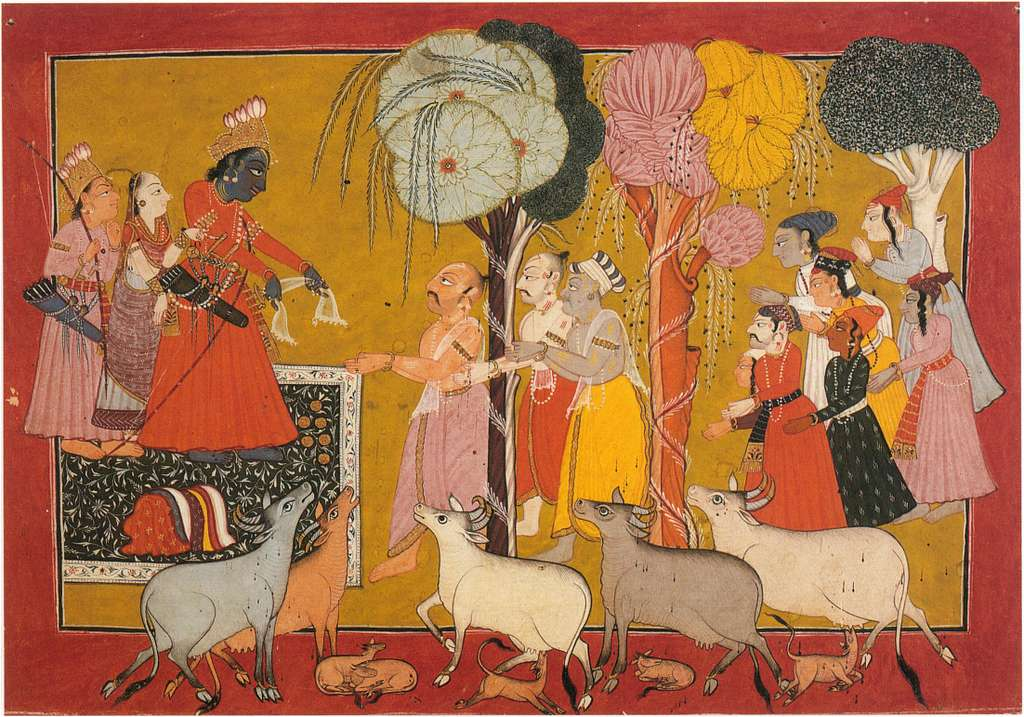
Before we can explain where the idea of money comes from, it is necessary to take a small detour to explain the desire to possess. After all, one of the main uses we give to money is to possess material things and also to control other people who work for us.
Do not think that by separating from God we completely forgot about Him. Deep in the mind of each person lies a burning desire to return home. God did not forget about us either. He constantly calls us with His love and speaks to us throughout the day, reminding us how much He wants us to return to Him.
On one hand, we feel attracted to God, and on the other, God attracts us as if He were a force of gravity. The Course calls these two forces “the irresistible attraction to God.”
When we think of the word attraction, we usually think of a romantic relationship. Inevitably, thoughts associated with desire, repulsion, and sometimes disinterest in certain aspects of the other person come to mind. However, in heaven, our natural state is one of total attraction to God. It is the only thing we desire; the elements of repulsion and disinterest are not present there. God is perfectly attractive.
In every relationship of attraction, there is a desire to belong. If you do not believe me, think of a soap opera - perhaps romantic movies - and remember phrases like “make me yours” or “you will be mine.”
Also beliefs like, “a family belongs to its own home,” or that some people believe that children belong to their parents.
The idea of possessing and being possessed is part of the nature of this world.
By separating from God, we did not lose that deep desire to belong. We desire to belong to God. There is such an irresistible attraction to God that we naturally want God to make us His own.
It may sound strange, but deep down, each of us desires to be possessed by God. Not in the sense that a spirit possesses a body, as seen in horror movies, but in the sense that a child belongs to their parents. That is the reality in heaven, and also in this world, even if we do not realize it. This is how Jesus explains it in the original dictation of the Course:
The truth is still that the attraction of God is irresistible at all levels, and the acceptance of this totally unavoidable truth is only a matter of time. But you should consider whether you want to wait, because you can return now, if you choose. (CE T-2.I.1:3-4)
In this world, however, we came with the idea of being separated from God. So that impulse of such irresistible attraction had to be suppressed.
One of the many ways we suppress that impulse is by avoiding God. For example, there are atheists who deny His existence. There are also those who believe in Him but think He is someone fearful or despotic and therefore undesirable. Interestingly, there are also those who want to believe in Him but strip Him of so many attributes that He ends up being a diluted God. For example, nowadays, we can hear many spiritual currents speaking of God as impersonal energy, the void, silence, universal consciousness, and also as a higher self. All these visions are attempts to avoid the desire to be possessed by God.
Suppressing the impulse of attraction is a strategy. But we also have another strategy up our sleeve: distorting the desire to be possessed by God into the desire to possess in this world.
Jesus typifies the four main ways in which we distort the attraction to God. I will only cover the first two forms that are relevant to the topic of money that we are discussing this time.
Anyone who has fallen in love in this world has experienced the desire to possess the body of their beloved. As I mentioned earlier, soap operas are full of phrases that reveal the human desire to possess another or to be made theirs. Jesus typifies this type of distortion with these words:
Possession can be associated with the body only. If this occurs, sex is particularly likely to be contaminated. Possession versus being possessed is apt to be seen as the male versus the female role. Since neither will be conceived of as satisfying alone, and both will be associated with fear, this interpretation is particularly vulnerable to psychosexual confusion. (CE T-2.I.3)
Here we can see that the classic roles of man and woman as a sexual couple are the product of a distortion. The man wants to possess the woman, and the woman wants the man to make her his. However, Jesus adds that neither role is satisfactory in itself, which leads to more confusion that is projected onto sex.
The second type of distortion occurs when we direct the desire for possession toward material things. This is the type of distortion in which money plays a part:
From a rather similar reference point, possession can also be associated with things. This is essentially a shift from type 1 and is usually due to an underlying fear of associating possession with people. In this sense, it is an attempt to protect people from one’s possessiveness, like the superstition about “protecting the name” we mentioned before. (CE T-2.I.4)
It is interesting to read that the desire to possess material things is a form of protection. It is as if the first distortion we resort to is the desire to possess other people. However, this causes fear, perhaps because we might harm the other person. The solution we find in our confusion is to divert the desire to possess bodies and turn it into the desire to possess material things. By diverting the desire, we think we are protecting the person whose body we wanted to possess.
Have you ever felt the urge to buy something expensive after a breakup or romantic disappointment? For example, I know several people who drown their sorrows in shopping when things do not go well in love. The idea proposed here is that this behavior is due to the fear caused by the desire to possess the other person.

Another interesting point that Jesus makes in his explanation is that many relationships are formed based on the first type of possession. But this is not what keeps them together in the long run. Once the romance fades, many couples remain together by sharing the desire to possess material things.
The desire to possess bodies and material things is an attempt to fill a void. Since these goals are relatively easy to achieve, the desires to possess tend to be compulsive. This means they can lead us to a state where our behavior becomes uncontrollable.
Superficially, the desire to possess bodies and things seems completely harmless. In fact, they appear to have the power to keep fear and pain at bay.
Did your partner leave you? It does not matter; there are plenty of fish in the sea, and ‘one nail drives out another!’
Are you sad? Let’s go shopping to lift your spirits.
What we do not realize is that the fear we are trying to keep at bay is the fear of returning to God. The tension created by not satisfying this deep desire grows day by day, making the internal void even more voracious. This can lead us to place even more faith in the first two distortions of the desire to possess. And the more faith we place in these solutions, the more emptiness and fear we generate. We could say we are imposing a regime of self-starvation on ourselves.
This voracious hunger, when taken to the extreme, results in highly undesirable and even criminal behaviors. Although very few reach this extreme, there is a fear in the mind of each person that, in the darkest part of our being, there is a latent criminal. Have you ever had a completely inappropriate thought cross your mind? The idea that you could actually do it is one of the many promoters of fear.
No one really wants to see themselves as the villain of the story. So, in the midst of confusion, we come up with very creative ideas to avoid reaching the extreme, hoping that this will reduce the fear. The Course says that these ego solutions follow this logic:
This means that the ego’s solutions to keep fear at bay involve making you less efficient in achieving the desire you want to fulfill. For example, people who accumulate great wealth and then go bankrupt, sometimes multiple times throughout their lives. These individuals drive themselves to lose everything as a way to reduce the fear and emptiness generated by their desire to possess material things. It is similar to having an internal ‘short circuit’ that forces them to reset.
Perhaps delving deeply into the topic of possession has helped you understand the role of money a bit better. We can see that money might be a means to satisfy our distorted impulses to possess and that money itself can become the object we desire to possess or that possesses us. There is nothing inherently special about money from this perspective. It is simply a deep need for God that has not yet been healed.
The Course teaches us to redefine our concept of possession as the path to healing the distortions we participate in:
The obvious correction for all types of the possession fallacy is to redefine possession correctly. In the sense of “taking over,” the concept does not exist at all in divine reality, which is the only level where real existence is a meaningful term. No one can be “taken over” unless he wills to be. (CE T-2.I.24:1-3)
This is achieved through miracles. Miracles, which are expressions of love, are designed to fill the void left from our separation from God. By satisfying the true need, the distortions must disappear. It does not matter what type of distortion arises or how difficult and persistent it may seem. The miracle can heal it:
It is emphasized here that these differences have no effect at all on the miracle, which can heal any of them with equal ease. (CE T-2.I.21:1)
Just like in the previous practice, we will use the response to temptation and frequent reminders.
Observe your mind throughout the day. The thoughts you are looking for are those that indicate you want to possess or be possessed by something external. We have already seen some examples, but I will repeat them here:
Many of these things are part of “normal life” and may not seem like thoughts to you. That is why you need to be very vigilant to recognize the moments when you think you want these things. Once you have identified the thought, respond immediately:
“I am confused because I think possessing ———- is what will bring me happiness [peace, freedom, etc.]. What I am really seeking through this is to belong to God.”
Just like in the previous practice, close your eyes and say these words very slowly, letting their meaning enter your mind and help you change your perspective. When you feel an internal shift, that will be the moment to stop. If you feel resistance, try to continue for a few more seconds. If the resistance persists, that will also be the moment to stop.
Additionally, set your phone timer to remind you every 20 minutes of this idea:
“Today, I will not fight against my irresistible attraction to God.”

In the introduction, we said that one view of money is that it is intrinsically evil, the root of all evils. Somehow, we have ingrained in our subconscious the idea that money is the cause of the many problems we experience. Who has not thought that without the unjust systems imposed by money, we would have a better society and a better world? And who has not thought that money has the power to corrupt anyone? “Everyone has their price,” says a famous saying.
Jesus tells us in the Course that money is an effect of a prior cause and therefore cannot be attributed with evil:
The authority problem, not money, is the real “root of all evil.” Money is but one of its many reflections, and is a reasonably representative example of the kind of thinking which stems from it. The idea of buying and selling implies precisely the kind of exchange that the spirit cannot understand at all, because its own supply is always abundant and all its demands are fully met. (CE T-4.II.1:3-5)
Separation can be understood as a process we undertook with the goal of becoming our own authors. First, we denied God as our divine Author and then embarked on a journey where we imagine that we create ourselves. The course calls this “the problem of authorship.” The problem is that we are confused about who our author is.
You can imagine this as pretending to leave home, hitting your head, and due to your amnesia, not remembering who your father is. However, just because you have forgotten does not mean your father stops being who he is. A simple paternity test could prove where you come from.
What Jesus says is that being confused about who created you is the root of all evil. Money is not the root, since money is just one of many reflections of the authorship problem. Here, Jesus is freeing money from the old and prevailing view that it is the cause of all evil. We might automatically think that Jesus is aligning with the modern view that money is intrinsically good, your divine right, a demonstration that you are doing God’s will.
However, Jesus does not align with that view either. It is clear in this paragraph that Jesus categorizes money as part of the problem by saying it is a concept that arises as a product of the authorship problem. In fact, he says that the idea it represents is the opposite of what happens in heaven.
At the end of the previous quote, we see that heaven is described as a condition where we are always abundant and have no needs. The language used is clearly associated with the formulation of the basic economic law of “supply and demand.” If there were an economy in heaven, we would say that supply is always abundant and demand is always completely satisfied.
In what sense is money a representative example of the authorship problem? Separation carried out a process of inversion as seen relative to where we are; metaphorically speaking, separation from God puts us, in a sense, “upside down.” That is, what is true in heaven, being inverted, ends up being the opposite in this world. In heaven, supply is always abundant, and demand is always satisfied. However, money, being a reflection of the idea of separation, ends up exemplifying contrary laws. In this world, supply is scarce, and demand is never satisfied. Money is that crazy idea that arises in a world where scarcity reigns.
The way to rid ourselves of the idea that money is the cause of our problems, even if only for a few of them, is by resolving the internal problem of authorship, also called the problem of authority in the course. As long as we believe that there are external or internal things that have the power to cause the calamities we experience, we are confused about who created us. Jesus emphasizes the importance of resolving this problem as soon as possible:
It is essential that this whole authority problem be voluntarily dismissed once and for all. You do not understand how important this is for your sanity. You are quite insane on this point. (CE T-3.XI.1:1-3)
Interestingly, the way to rid ourselves of this problem is by recognizing that it is a fictitious problem, a problem we have believed is there but is actually an illusion. How can we understand this? We find the key in these paragraphs:
Peace is a natural heritage of the Son. Everyone is free to refuse to accept his inheritance, but he is not free to establish what his inheritance is. The problem which everyone must decide is the fundamental question of his own authorship. (CE T-3.X.11:1-3)
And also,
You cannot find peace while this authority problem continues. But the truth is still that there is no problem about this. There is no one who does not feel that he is imprisoned in some way. If this has been the result of his own free will, he must regard his will as if it were not free, or the obviously circular reasoning of his own position would be quite apparent. Free will must lead to freedom. (CE T-3.X.12:1-5)
The authority problem can be reduced to a simple phrase: “My will and God’s are different.” If they were the same will, there would be no authority to oppose and no problem at all. So, the problem is that I have used my free will to oppose God’s will. I have opposed His will by believing that I am the author of my own reality.
Each of us thinks we can shape reality as we please. That we can build our identity as we wish through our actions and the stories we weave. We plot our own story and build our own image with each passing day. We have a strong attachment to being the authors of our own reality.
If I have money problems and peace is my natural inheritance, that means I am denying my inheritance. The evidence that I am denying my inheritance is that I do not have peace due to these problems, or because I feel like a prisoner of circumstances; and not the fact of not having money. Since God’s will is my inheritance and my inheritance is peace, that means I have chosen to live contrary to God’s will. Therefore, I am using my free will to imprison myself. Complete insanity!
We do not realize this circular and insane reasoning because, instead of thinking that we have used our freedom to imprison ourselves, we simply think that our will cannot be free. And that we are at the mercy of the will of the world and other people.
Can I accept without reserves that another Being is responsible for my existence and who I am?
Can I accept that I used my freedom to deny my Creator?
Can I use my free will not to imprison myself but to be free?
Why would I not accept peace, which is my inheritance?

The way to apply these ideas in practice is by declaring your independence from the things that seem to define who you are. What things in this world do you believe define you? What things in this world have the power to alter your image?
Today, we will spend the day identifying those things that seem to be our author and declaring independence from them. Some examples:
Stay alert throughout the day to identify any thought that seems to indicate that the world is your author and has the ability to dictate who you are or how you feel. You will easily know this whenever you see that you have lost your peace. Each time you identify such a thought, immediately respond with the truth by saying:
I made up the idea that ———- has the power to alter me. But my true author is God, and my inheritance is His peace.”
For example, if you find yourself distressed about a debt or because someone has a bad opinion of you, you can say:
“I made up that this debt has the power to alter me. But my true author is God, and my inheritance is His peace.”
“I made up that this opinion has the power to alter me. But my true author is God, and my inheritance is His peace.”
As usual, remember to say the words very slowly and feel their meaning. It is not about repeating them like a parrot, but about allowing yourself to feel how the content those words represent has the power to dissolve illusions. Remember to apply the response to temptation until you feel an internal change. It might also help to say them with a sense of declaring your independence from those external things.
Additionally, set your phone timer to remind you every 20 minutes of the truth. It is important to keep a true idea in mind throughout the day; otherwise, your mind will get lost in daily distractions and you will think again that the world is your author. You can use this phrase:
My worth is not determined by anything in this world. My worth was established by God.

Previously, we saw that by separating from God, we created the first and only lack: the lack of God. This lack fragmented and transformed into thousands of needs. These needs were projected onto the body, and now it seems that the body is what lacks things and requires our attention. We also said that the body is the symbol of separation. Feeling its needs and working to satisfy them is the way to prove that separation is real.
When someone asks you to tell them about yourself, isn’t the story you tell them the story of your body? The place and date where your body was born, the house where your body lives, the partner your body is with, the illnesses your body has gone through, the countries it has been to. The body is the “hero,” the protagonist, of your movie. Everything revolves around it. We see the body as a full-fledged person.
Since we are so deeply identified with the body, it’s natural that we want to tend to its needs. It’s expected that we want to pamper it, protect it, and listen to it. The body asks, and the mind obeys by seeking what is needed to appease its desires. From this perspective, the idea that the body itself doesn’t need anything sounds absurd. However, this is what the Course teaches. It is explained in Chapter 27:
The dreaming of the world takes many forms, because the body seeks in many ways to prove it is autonomous and real. It puts things on itself that it has bought with little metal discs or paper strips the world proclaims as valuable and good. It works to get them, doing senseless things, and tosses them away for senseless things it does not need and does not even want. It hires other bodies, that they may protect it and collect more senseless things that it can call its own. It looks about for special bodies that can share its dream. (CE T-27.X.2:1-5)
What this paragraph means is that we have designed a system of thought that teaches us its fundamental lesson: “… that it [the body] is cause and not effect, and you are its effect and cannot be its cause.” (CE T-27.X.3:4).
Let us remember that the body only became part of our experience after we decided to separate from God. The body is an effect of the mind and has never ceased to be so. The truth of this idea is stored within us and constantly surfaces, although we do not take it very seriously.
For example, when we hear someone judge another by their physical appearance, we think they are a shallow person. Intuitively, we know that what is inside is what matters. When we hear that others are treated as if they were objects, we also feel indignation. We are inspired by stories of people who overcame their physical limitations thanks to their willpower because deep down, we know that the body is like a prison, and the mind longs to be free.
Through the ages we have imposed onto ourselves a system of thought that teaches and reinforces the idea that the body is cause and the mind is its effect.
This system of thought starts with the idea that the body has its impulses and needs, like feeling cold - an impulse that tells us the body requires clothing and other accessories.
To procure these things, we need money, and to have money, we must work hard.
We strain the body for strips of paper, metal discs, and numbers on a bank screen. We invent countless meaningless activities to obtain those strips of paper. But do we stop when the need is met?

Instead of simply meeting a specific need, we end up squandering money on things we neither want nor need. Who cannot relate to this? Who has not wasted money on things they never used? Who has not bought things they truly did not need? We work hard to obtain something we will later discard. What sense can this make?
Yet, this system makes so much sense to us that we use the same strips of paper and metal discs to hire other bodies to do the work for us. Their job is to collect “more meaningless things” for ourselves. We also look for that special person with whom to share the illusion of acquiring more money that can be wasted on more unnecessary things. Possessing for the sake of possessing is one of the ego’s slogans. Like everything from the ego, it ends up being circular reasoning. Money serves the body, and the body serves money. The mind remains a victim of this cycle.
Jesus has a good sense of irony. When seen in this light, the entire system becomes laughable for how absurd and senseless it is. Can you see the absurdity of it all too?
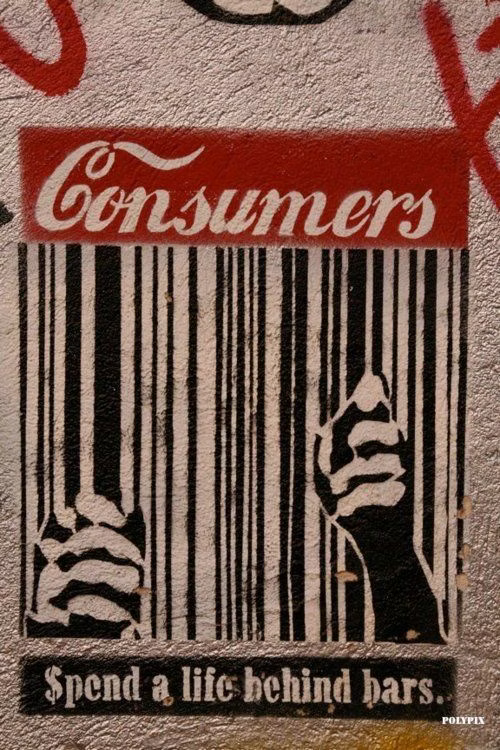
Many have dared to point out the absurdity of the system. For example, in 2008, as a result of a financial crisis, the “Occupy” movement emerged as a way to protest financial injustices. There are also anti-consumption movements that highlight the absurdity and danger of centering society around the idea of constant consumption of goods and buying products. These and many other similar groups protest the system because they can see the harmful effects it has on people and the environment. However, no group points out that the real problem is that we incorrectly believe that the body governs itself.
In this world, we see these problems as something very serious. We think that money is simply a fact we must live with because the body needs things. There is no doubt that we have learned very well the central lesson this system wants to teach us: the body is cause and not effect.
To prevent such an absurd system from spiraling out of control, we created rules and laws to follow. The Course assures us that, although we feel bound by these laws, we will feel deep liberation when we realize they are not really laws but part of a madness. It says this in Lesson 76 of the Workbook:
Think of the freedom in the recognition that you are not bound to all the strange and twisted laws you have set up to save you. You really think that you will starve unless you have stacks of green paper strips and piles of metal discs. You really think a small round pellet or some fluid pushed into your veins through a sharpened needle will ward off death. You really think you are alone unless another body is with you. (CE W-76.3:2-4)
It is insanity that thinks these things. You call them laws, and put them under different names in a long catalog of rituals that have no use and serve no purpose. You think you must obey the “laws” of medicine, of economics, and of health. Protect the body, and you will be saved. (CE W-76.4)
These are not laws but madness. (CE W-76.5:1)
There are many examples of these laws. For instance, the idea that we must earn a living. In the psychotherapy supplement of the Course, it says that we believe “it is ushered in by the belief that there are forces to be overcome to be alive at all.” (P-2.V.1).
That is, we think that life must involve effort for it to exist.
Another fundamental law is the law of supply and demand. In this world, supply is always limited, and needs are said to be infinite. According to the laws of the world, we think it is not our natural right granted by God, but a privilege we must fight for. Since supply is limited, we think we are in competition with others, who take away what we seek to live.
Jesus reminds us, however, that this law is madness and that by freeing ourselves from it, we will feel deep relief.
Let us then do what he proposes. Close your eyes for a few minutes and take time thinking about:
how you would feel recognizing that you are not bound by the laws of economics.
how you would feel realizing that you don’t have to make any effort to earn a living.
how you would feel recognizing that all those laws that seem to bind you are madness and that only the laws of God govern you.
Observe how you feel.
Isn’t that a goal you would like to achieve? Wouldn’t you put your body in service to this goal?
We have already seen that we tend to focus our lives on pleasing the body and put all our efforts into accumulating things that can satisfy it. We need to center the mind early in the day so that the goal is different. Today, we will introduce an additional element to our practice with this purpose. We will dedicate ourselves to starting the day well.
Dedicate about 15 minutes in the morning to the following practice:
Close your eyes and set your mind to look honestly, without deception.
Identify the beliefs you have about the laws of this world that you think you must obey. For example: “If I don’t eat, I’ll die,” “If I don’t earn money, I could get evicted,” “If I don’t take my medication, my illness will worsen,” etc.
For each belief, observe how that law makes you feel, especially when you imagine breaking it.
Release each belief with these words, said slowly and with full confidence that they will take effect:
“I believe that —————, but that is not true; I am governed only by the laws of God.”
For example:
“I believe that I would starve if I had no money, but that is not true. I am governed only by the laws of God.”
If you practice correctly, your mind will naturally reach a state of silence where you will find no more beliefs, and you will experience peace.
Spend the remaining time staying in that state and remind yourself that this is the state you wish to remain in for the rest of the day.
Since we have accepted the system we live in as normal for so many years, it is understandable that one morning meditation will not make it disappear immediately. For this, we need constant practice that offers a saner alternative.
Throughout the day, stay alert for any thought that suggests you must serve the body or that the body must serve money. These may include thoughts of anxiety about your work or desires to indulge the body in some craving. Be especially mindful of thoughts related to shopping or goals you want to achieve.
Whenever you catch yourself having a thought aimed at pleasing the body or achieving goals that serve the body, immediately respond with the truth:
“This thing I believe I need is not what will make me happy. I will be still and listen to the alternative God offers me.”
Always remember that the words should be spoken slowly and with attention to the meaning they carry. For example, when you say “I will be still to listen,” do exactly that.
Additionally, set a timer on your phone to remind you every 20 minutes to keep your focus throughout the day:
“Today I will not waste time trying to prove to myself that the body commands me.”
Human beings are often in a constant struggle to avoid pain and seek as much pleasure as possible. The Course offers us a different objective.
The Course teaches us that what shares the same purpose is the same.
In this sense, pleasure and pain are the same, as they share the same purpose, and that purpose is to keep us separated from God.
We all want our pain to be healed, but almost no one has considered that they must also be healed from their pleasures.
The Course teaches us that it is not necessary to fight against the temptation of pleasure, but rather, we must align our efforts with accepting the miracles that God offers us, so we can be witnesses to the world of a more sensible alternative.
If all your efforts are focused on this new objective, money becomes entirely secondary in your life, and you allow God to be the one who provides for your needs.

In a system where supply is limited and needs are infinite, it would be rational to buy only what we need and what helps us feel better. Curiously, we do the exact opposite. The Course is full of phrases referencing our tendency to buy things we do not need and that, in reality, harm us. Not only are we living in madness, but in our madness, we are hurting ourselves through the things we believe we desire and obtain.
One of the most prominent quotes where we see this idea is in chapter 13, where Jesus tells us what the real world looks like:
[In the real world] There are no stores where people buy an endless list of things they do not need. (CE T-13.VII.1:4)
Here, He is once again telling us that we use money to cover imaginary needs and also to satisfy unnecessary whims. As we saw earlier in the quote from chapter 27, not only do we buy things we do not need, but we waste money on “things, and tosses them away for senseless things it does not need and does not even want.” (CE T-27.X.2:3)
For example, as I write these lines, I glance at a flowerpot I bought months ago. It has no plants in it because I had no plants to put in. Clearly, I bought something I neither needed nor wanted. If I truly wanted it, I would have planted something in it by now.
On one occasion, Jesus told Helen that she had wasted more money than her husband had ever earned in his entire life. Helen was known for her love of shopping. In this statement, Jesus was telling her that all her purchases amounted to squandering more money than her husband had managed to accumulate throughout his life.
This may seem trivial. What is wrong with this? Who does not enjoy going shopping, finding something interesting and beautiful, and taking it home? It seems like a harmless process, especially if you have the money to afford a little indulgence. However, the Course teaches us that we are actually asking for what harms us.
For example, in Lesson 133 of the Workbook, it says:
When you let your mind be drawn to bodily concerns, to things you buy, to eminence as valued by the world, you ask for sorrow, not for happiness. (CE W-133.2:1-2)
Pause for a moment and carefully read the previous quote. Do not let its depth escape you. Who would have thought that allowing your mind to focus on things you need to buy is inviting sorrow? On the contrary, we think that if we do not focus on these things, sorrow will come to us sooner rather than later.
The reason for this takes us back to the first chapter of the series. The first and only lack we have is the lack of God. We are convinced that we have a hole inside that needs to be filled with external things. But that hole is not really there, and it cannot be filled with things from the outside. When we try to fill that void with external things, we are actually making the feeling of emptiness even greater; we are inviting sorrow, not happiness.
When we desire external things, we are truly asking for what has no value. The only thing that has real value is love. In Lesson 133, we also find this line:
if you choose a thing that will not last forever, what you choose is valueless. (CE W-133.6:1)
The topic of shopping is, therefore, not a trivial one. Instead of being an essentially harmless act, it is something we do that brings us sorrow. Instead of filling us with a sense of wealth, it makes us feel surrounded by what is worthless.
If we are choosing what has no value, how do we recognize this and start choosing what does have value? The Course offers a very practical teaching on this. To begin practicing what it teaches, we must familiarize ourselves with two principles:

Armed with these two principles, we can now explore the techniques the Course provides to distinguish between the only two alternatives.
Jesus gives us four criteria that we can use to know if we are choosing something that will bring us pain.
The Course teaches that only the eternal is real. Although we believe our life is limited to the body, our soul will live on after the body is gone. Your being will endure beyond the lifespan of this planet, the stars, and even the entire physical universe. If there is something that will not continue to exist just like you, then it cannot have real value.
This criterion seems to encompass too many things; in fact, it is difficult to think of exceptions. But even in this world, exceptions exist. You just have to think about the purpose assigned to things. For example, you can buy a house. The house will not last forever, but if the house has the purpose of providing a place of union where holy relationships are formed, then the purpose of the house is not perishable.
When you try to obtain something by depriving someone else of it, you can be absolutely sure that what you desire is nothing. It has no value. The underlying reason is that everything we deny to others, we unconsciously deny to ourselves. We may end up obtaining what we wanted to take from another, but at the same time, we are denying it to ourselves, which will make any joy fleeting or impossible.
These questions must be answered with great honesty. Are you trying to satisfy your ego’s interests at the expense of others? Jesus says it is very easy to deceive yourself when answering these questions. Do not think you are immune to self-deception.
What we usually do is lie to ourselves about why we want something. Around our selfish intentions, we place a heroic and noble reason. Sometimes, we justify it with a story of victimhood and entitlement. Other times, we say that we are simply teaching others a fair lesson. There seem to be a million different ways to justify selfishness, but they usually form on two levels:
Superficially, we tell ourselves that our intentions are pure. That we simply seek the best for everyone.
Underneath, we believe that we can gain at the expense of others. This creates an internal sense that we have done wrong and bear the stain of sin. It feels as if you became a millionaire but at the cost of scamming your own family.
The first level is simply a mask of innocence. We put on the mask because deep down, we feel guilty. We get defensive when someone tries to unmask us.
Fortunately, both levels are self-deception. It is not true that we want things for pure reasons, and it is also not true that we have gained at the expense of others. Let us remember the second principle: We either win everything or win nothing. By believing that we can gain at someone else’s expense, we are gaining nothing. The fortune we earned by scamming the family was not a fortune after all. It was nothing.
If your reasons are pure, why do you feel guilt? Feeling guilt is proof that you are choosing something that has no value. If you are defending your innocence, then it is simply a mask.
This is the last criterion to apply. If you feel even the slightest trace of guilt about what you decide, then you are supporting the ego’s goals and choosing what harms you.
Imagine being able to buy and own things and not feel any guilt about it. It is possible if you stop choosing what has no value. In every decision where you are unsure of what to choose, be sure to apply these four criteria. You will likely change your mind about the goal you want to achieve.
When you have a few minutes in the day to do this
exercise, grab some paper and a pencil to take notes. Spend
several minutes writing down as many things as come to mind that you
would like to achieve, reach, or obtain. Here’s an example: - Desire:
___________ - Is it forever? Yes/No - Does it take
something from someone? Yes/No - What purpose does it have? - Do I feel
guilty? Yes/No
For each desire, take a few moments to honestly answer the four criteria. Honesty is key in this exercise, especially with the last criterion. Guilt is often hidden under other names. If you feel the slightest trace of guilt about your desire, even if it seems justified and you feel it is something ‘you deserve’, answer “yes” to that question.
Once you have listed your desires and answered the four criteria, decide if the goal you are pursuing is from the ego and therefore a goal that will harm you. Then you can say to God:
I really do not want what will harm me. Show me what goals I need to achieve.
We will again dedicate 15 minutes in the morning to practicing the ideas we are learning today. The goal is to spend most of those fifteen minutes in mental silence and in connection with God. We will do this using the following technique:
Throughout the day, observe your mind. You will be looking for thoughts that tell you that you desire something. It can be a material or immaterial goal. Try to mentally review whether this goal is pursuing something truly valuable by applying the four criteria. If you find yourself desiring something that has no value, say to yourself:
Today I will not give value to what has none.
Use your phone’s timer to remind yourself at least every 20 minutes that today you will not desire what harms you. Remember this phrase and say it slowly, so that the words take on meaning in your mind:
Today I will not harm myself by giving value to what has none.

Research in social sciences coined the term “miswanting”:
“Miswanting” refers to the phenomenon of desiring or pursuing things that do not contribute to long-term happiness or well-being. It implies a disconnection between what an individual believes will make them happy and what truly brings satisfaction.
The idea of miswanting is that we are convinced we know what we want, but once we obtain it, it does not bring happiness.
For example, an experiment was conducted where a group of people was offered 20 dollars with the option to spend it on themselves or on someone else. Before choosing one of the two options, participants had to predict which option would make them happier. The result was that most chose to spend it on themselves, but these same people reported the least happiness after a week. However, those who decided to spend it on others, even without predicting that this would make them happier, were the ones who reported feeling happier after a week.
It doesn’t sound very intuitive. We usually think that we know exactly what we want. That we just need to trust what our heart tells us. Follow our dreams. However, this is a point where both social sciences and A Course in Miracles agree: what we think we want is not what will make us happy.
The true reason why we do not find happiness in our possessions is not because we possess the wrong things or because we have too many or too few possessions. The reason is that possessing increases our sense of separation. This idea may surprise you, but we can look at it this way.
When you possess something, who else possesses it with you? Only you, at most your closest family. Possessions intensify the feeling of being an isolated self, separate from the rest of the world.
When you have something that few people have, don’t you feel special or superior? Have you ever felt the need to hide or downplay the things you have to avoid causing envy in others? Or on the contrary, have you ever used your possessions to present yourself as special and cause envy?
When you possess something, where is the light of God? Having your attention focused on the things of this world is equivalent to closing your eyes to the light that God wants to give you. That is the light that unites us with Him and with all. Possessions are truly a way of dimming ourselves.
When you want to possess something or have to work to maintain it, you are distracting yourself from seeing that what you want to possess has no value. This distraction is a form of separation because it prevents you from seeing reality.
When you enjoy a possession, which can be material or simply a pleasurable experience, isn’t the body the target of this enjoyment? The body, as we saw before, is the symbol of the separation from God. By treating the body as an end, we are reinforcing the barrier that separates us from the rest of the universe.
In general, the sense of separation and isolation that possessions cause is hidden in the unconscious. If we paid attention to what we feel, we would realize it immediately. However, the very idea of having possessions is a defense against the process of looking within and realizing that it is making us miserable.
In the movie “Into the Wild,” there is also a good example of this. It is a movie based on a true story of a man who abandons everything he has and becomes a wanderer. His dream: to live free in the wild nature of Alaska. While in Alaska, due to an accident, he ends up dying alone and in the middle of nowhere. In a diary found next to his body, he wrote his last words: “Happiness is only real when shared.” This person embarked on the journey of his dreams, only to realize that happiness was with the people he had left behind. His most precious “possession” was freedom from his body, being free from the ties of others, but his sense of isolation ended up making him die in regret.
I have had clear glimpses of that same truth. On many occasions, in the middle of a vacation in a place I was supposed to be enjoying, I have noticed that joy was absent. Despite being in a spectacular place, drinking cocktails by the sea, the happiness I had imagined having while doing that was absent. The sense of separation settled in despite nothing external in my life going wrong.
The idea that we are desiring something that is not what we want is what the Course calls an “alien will.” This alien will, the will of the ego, is what keeps us in a state of dissatisfaction. This is explained in Lesson 339:
Everyone will receive what he requests, but he can be confused indeed about the things he wants; the state he would attain. What can he then request that he would want when he receives it? (CE W-339.1:3-4)
The Course calls it “alien will” because, although it may seem like your will, it is not truly what you want. Your true will is the will of God. It is an idea that seems hard to accept.
In this world many of us think that:
Nothing could be further from the truth. Our true will resides in Heaven and is shared with God. The Course aims to free your true will, not restrict it. When we think God is recommending something we don’t want, we are actually fighting against what we genuinely want. We are convinced that the “alien will” is our own.
We hold a grudge against God because we believe He is behind the feeling that our will is not free. If we could forgive God for this insane belief we harbor and recognize that He has always been on our side, we would unlock our true will in this world. This would translate into desiring and pursuing what would truly make us happy.
We need to forgive God. Your free will depends on it:
But you will not forgive the world until you have forgiven Him Who gave your will to you, for it is by your will the world is given freedom. (CE T-30.II.5:2)
All God asks is that we see Him as a friend:
God is no enemy to you. He asks no more than that He hear you call Him “Friend.” (CE T-30.II.1:10-11)
We will dedicate 15 minutes this morning to the following exercise. You will need the desire list you created in the previous lesson. Follow these steps:
I believe I want
_______, but I suspect it is a miswant. Show me, Father, what will truly make me happy.
Imagine that God receives the gifts you offer, and He returns to you in the form of a loving light what you truly need. Trust that this light will take shape in your life in a way you can understand and appreciate.
We will continue our practice of responding to temptation today, with the aim of starting to open our minds to the idea that you do not know what you truly want. It is crucial that we accept this fact, for otherwise, we will not accept God’s help willingly. God knows what you truly want and need, but as long as you remain in a struggle of wills with Him, you will think that the desires you have now are what will make you happy.
So, throughout the day, watch your mind for any loss of peace, no matter how small. What is a loss of peace but a tantrum about not getting the things you want and the way you want them? Immediately remind yourself that you do not know what is best for you, but there is someone walking beside you who does:
I believe I am upset because I want
_______and don’t have it. But I am confused about what will make me happy. What is my true will in this, Father?
For example, if you feel upset because a debt hasn’t been paid, because your work is unappreciated, or because you wish you were doing another type of job, say:
I believe I am upset because I want to be paid what I’m owed and haven’t been. But I am confused about what will make me happy. What is my true will in this, Father?
Repeat these words very slowly, and pause at the end to allow God to remind you of what you truly desire. Do this until you feel an internal shift, even if it’s small.
You might be tempted not to repeat the phrase because you think God will want the opposite of what you want, and therefore you will be unhappy. If this thought arises, correct it by saying:
God is not my enemy. He only wants to hear me call Him “Friend.”
With the help of your phone’s timer, remind yourself every 20 minutes with the following phrase:
God’s will for me is my perfect happiness.

Let’s revisit the topic of possession. We previously discussed the belief that if we do not accumulate piles of money and inflate the number in our bank accounts, we will be at the mercy of those forces that want to take our lives. The idea of possessing and accumulating is the logical consequence of the belief that there is a limited supply and infinite needs. Under this belief, we think that unless we possess and accumulate, the needs of others will overtake us, leaving us with nothing. Possessions, therefore, become highly valued because they can be used for exchange and give us a sense of safety.
Possession, exemplified by money, can become an end in itself, rather than a means to meet needs. In other words, possessions become a measure of the “self.” When you see someone with a lot of money, through the things they wear, the car they drive, the trips they take, don’t you think that person is “more” than you? We are convinced that the more possessions one has, the better one is.
The logical conclusion is that to reach that level where others are, you must focus your efforts on buying and owning more and more things. What we don’t realize is that the ego has a plan behind this. In chapter 13, we find a good explanation of the ego’s plan:
Ownership is a dangerous concept, if it is left to you. The ego wants to have things for salvation, for possession is its law. Possession for its own sake is the ego’s fundamental creed, a basic cornerstone in the churches that it builds unto itself. And at its altar, it demands you lay all of the things it bids you get, leaving you no joy in them. (CE T-13.VIII.1:7-10)
Most religions in the world contain the idea of sacrificing something to god or gods. Usually, when we think of sacrificial rituals, we think of someone sacrificing a lamb. It’s a cruel idea, not just for the poor animal. In ancient times, a lamb was a luxury item. The lamb could be used for its meat, its wool, for reproduction once it matured, and also for trade for other goods. However, the god to whom the sacrifice was offered demanded that the lamb be completely lost.
This paragraph takes us back to that time to show us how unjust and cruel it was to sacrifice something valuable at the whim of a god. Then it shows us that by “placing on its altar all the things it orders you to obtain,” we are elevating the ego to the same category as a god. The ego is not something external, nor a living entity, yet we think it is. It is the ego, your desire to be separate, that orders you to obtain things only to sacrifice them on its altar.
It seems like an abstract and useless idea. But once you see the effects of this idea in your world, it will be obvious to you. How do we sacrifice what the ego asks us to obtain on its altar? The reasons were studied in the previous section. If the ego asks you to obtain things to elevate your “self,” to make you more special, then the things you possess will be destined for that purpose and not for your happiness. Elevating your “self” and making you more special is the idea of standing out.
Standing out sounds like a wonderful idea. Your mind tells you, “that’s where happiness lies!” But the idea of standing out is the idea of being in a separate class, and this idea is ultimately the idea of being alone. Just like those who sacrificed a lamb, when you obtain things with the purpose dictated by the ego, you will also be sacrificing them and ending up with nothing.
For this reason, always distrust what you tell yourself you need:
Everything that the ego tells you that you need will hurt you. For although it urges you again and again to get, it leaves you nothing, for what you get it will demand of you. And even from the very hands that grasped it, it will be wrenched and hurled into the dust, for where the ego sees salvation it sees separation, and so you lose whatever you have gotten in its name. Therefore, ask not of yourselves what you need, for you know not, and your advice unto yourself will hurt you. For what you think you need will merely serve to tighten up your world against the light, and render you unwilling to question the value that this world can really hold for you. (CE T-13.VIII.2)
Here, we see once again the idea of ‘miswanting.’ Additionally, it describes a process that the ego uses to ensure there is no joy in anything you possess. It is a truly fascinating process. This process explains many experiences I have had with possessions. I am sure you have experienced it as well. I simplify it here to make it more obvious:
This process was ‘immortalized’ in the famous saying that there are two moments of happiness in a man’s life: the day he buys a boat and the day he finally sells it. The idea behind this saying is that every man longs to have his own boat, but once he gets it, he realizes how much maintenance and trouble owning a boat brings. The only way to regain happiness is to get rid of the boat.

Think of a personal example of something you always wanted, but once you obtained it, it wasn’t what you imagined. Perhaps it turned out to be more work than you wanted, or it came with so many problems that you couldn’t enjoy it. Maybe it was something so fleeting that you barely had time to enjoy it.
In my case, there have been many trips I have taken in my life. I desire these trips in my heart, but the process of preparation, planning, and even being at the destination, I often realize that I have little time to truly enjoy the trip itself. When I finally get accustomed to the place, the trip is about to end, and I start feeling nostalgic for the days I spent there.
And who hasn’t experienced obtaining something they really wanted, only to realize it didn’t bring as much happiness as expected? I have lived through this more than once, and when others ask how I feel about this new possession, I feel obliged to say I am very happy, even when I didn’t feel any different.
You’ve likely also had the experience of possessing many things and, in the process, feeling like the things possess you. You become a sort of slave to your own possessions, having to work for them by maintaining or solving problems they bring. This reminds me of my mother’s beach apartment, where every time we visited, the air conditioning was broken. So, the first day of every beach vacation was spent running errands—finding someone to fix the AC, paying for electricity, paying for water, and discovering that the pool wasn’t working. The next time, it was always the fridge that was broken, or a window letting in the salty air.
The conclusion to all of this is that the desire to possess, when controlled by the ego, leads us to desire things that will end up hurting us. It does this by ensuring they become problems for you, preventing you from fully enjoying them. Normally, one would think the solution to the problem is to rid yourself of any thoughts that cause conflict, guilt, or pain so you can enjoy your possessions. However, Jesus explains that the problem begins when you believe you know what you want.
In a very emphatic way, Jesus tells you not to ask yourself what you want, because you don’t know. The answer you give yourself will cause harm.
Today, we will spend about 15 minutes getting in touch with the reality of what we have tried to possess, we have placed on the ego’s altar, which has deprived us of the joy it promised:
“I now place this possession on Your altar, Father, so You may return to me what You truly want me to have.”
Imagine truly giving each of these things to God’s light, and receiving back a gift that brings you relief. When you can no longer find anything else in your mind, use the silence to be with God for a few more minutes. End with this phrase:
“I leave all my needs to God today. Under His guidance, my journey will be light and without obstacles.”
As you can see, this first part of the series is to question them and give them to someone who truly knows what is best for you. Today, we will continue developing this skill.
Whenever you notice that you are desiring something from this world, no matter how much you believe you need or want it, say as honestly as you can:
“Holy Spirit, give me what I need in this situation because only You know what it is.”
Set the timer on your phone to remind you every 20 minutes of the last part of that phrase:
“Holy Spirit, only You know what I need.”

We have learned that we tend to desire things we do not truly want, things that will also harm us. But what about needs in this world? Can money at least satisfy those? After all, it seems evident that money has the power to buy the things we need and serves as our sustenance. However, the Course responds with an emphatic no to this question. When we believe that money can sustain us, the Course says we have placed our faith in the most trivial and absurd symbols.
In Lesson 50 of the Course, we find this:
Here is the answer to every problem that confronts you today and tomorrow and throughout time. In this world, you believe you are sustained by everything but God. Your faith is placed in the most trivial and insane symbols: pills, money, “protective” clothing, influence, prestige, being liked, knowing the “right” people, and an endless list of forms of nothingness which you endow with magical power. All these things are your replacements for the love of God. All these things are cherished to ensure a body identification. They are songs of praise to the ego.
Do not put your faith in the worthless. It will not sustain you. (CE W-50.1-2)
For most of us, seeking things like money, medicine, protective clothing, and good connections can give us some sense of being sustained. There is no doubt about that. But do we feel protected in all circumstances? Do we feel truly beyond any trial life may put before us? Do we feel perfectly surrounded by peace? Certainly not. Lesson 50 says that, in this world, we can reach a state of mind where nothing can disturb or threaten us. Can money give us that?
No matter how many things we acquire for the body, the need for peace will always leave us feeling empty. There is no amount of money, pills, connections, or clothing that can bring us that peace. It is a well-studied fact that people report no significant increase in happiness when they receive a salary increase beyond a certain threshold. The happiness that money can buy is very limited and fleeting.
We cannot deny that if we look at the list of items mentioned in the first paragraph of the quote, these are the things we most value in life. Who does not need clothing to protect against the elements? It is a very radical teaching to say that these are unnecessary. Yet it makes perfect sense. As long as we are convinced that these things sustain us in this world, we will have made the body our identity and left God’s sustenance forgotten.
The idea that we do not need things to sustain the body is so radical that it sounds ridiculous. To the surprise of many, the evidence that this is possible is not as distant as we might think. A remarkable example is the Dutchman Wim Hof, who became famous for holding the record for the longest time submerged in an ice pool and for running marathons in the snow completely barefoot. If that does not seem impressive, consider that he also climbed up to 7,400 meters on Mount Everest wearing only shorts and sandals.
Another experiment conducted with students of his method involved injecting them with a substance that causes flu-like symptoms. Those who participated in the experiment were able to instruct their immune systems not to react to the substance and experienced no symptoms.
Another remarkable example is Prahlad Jani from India, who claimed not to have eaten from 1940 until 2020. The interesting part of his case is that Jani was the subject of several medical studies, where he was kept in absolute isolation for days while his vital signs were monitored, ensuring he did not eat. All studies concluded that Jani could indeed survive without food with no change in body mass.
At the very least, these examples show us that the mind has power over the body, even if only in certain areas of control. In other words, they demonstrate that the body is an effect, not a cause. These are extreme examples, and I present them here only as a reference and not to encourage you to attempt them. They are useful examples to show us that money as a means of sustaining the body is an idea that can be discarded.
The good news for us is that the Course does not aim for extreme states. The true purpose of the Course is to let God satisfy your needs. Instead of pursuing money as an intermediate goal to then be able to buy what you need, the idea is to let God take charge of providing what your body needs to sustain itself while you are here in this world.
To progress toward this goal, we must first question whether we truly feel sustained by money. I believe there is no doubt it helps us survive and perhaps excel in certain areas. But do we really feel sustained by money? Can anyone honestly say they feel protected in every circumstance by the money they possess? I am sure no one feels perfect peace because of the possessions they have amassed in life. It is undeniable that there is no amount of money, medicine, shelters, or pleasures in the world that can truly give you lasting peace and a sense of being beyond all trials or tests. So, why do we continue deceiving ourselves with these fantasies?
The researchers who conducted the study I mentioned earlier asked the same question. If it is true that spending money on others brings more happiness than spending it on oneself, why do we not do it more often? One hypothesis is that we are not allowing these experiences of happiness to teach us in return and ultimately change our perspective. In our case, we know very well that money cannot truly sustain us, but we are not letting the experience teach us and change our view.
The second step to move toward the goal of letting God satisfy your needs is simply to allow Him to do so. If all our mental energy is focused on devising strategies to obtain money and carrying them out, then you will not have the time to do what He recommends. You will likely not even have the time to ask Him or the mental focus to listen.
In our experience, money has met our needs in the past. But how often have we allowed God to be our sustenance? Let us not place our faith in what cannot sustain us, but rather trust that God will take care of all things.
Let us use the practice instructions from Lesson 50 as our morning meditation. For 10 minutes, do the following:
Throughout the day, monitor your mind to observe thoughts suggesting that external things are needed to sustain your existence. Whenever you feel in need or lacking, respond immediately:
“The Love of God is my sustenance.”
Use your phone’s timer to remind you of this phrase every 20 minutes:
“The Love of God is my sustenance.”
Monitor your mind to observe thoughts suggesting that external things are needed to sustain your existence. Whenever you feel in need or lacking, respond immediately:
“The Love of God is my sustenance.”
Use your phone’s timer to remind you of this phrase every 20 minutes:
“The Love of God is my sustenance.”

Everything we consider valuable, we want to store somewhere safe. For example, we keep our money in the bank, our jewelry in a jewelry box, and when traveling, we lock our passports in the hotel safe. Scrooge McDuck stores his wealth in a giant vault.
How would you feel if someone told you to look again at where you have stored your treasures, only to find it empty? This is precisely what the Course says. Wherever we store our physical treasures, that place is, in fact, empty.
Lesson 344 expresses this idea using the metaphor that our treasure chests are empty:
I did not understand what giving means, and thought to save what I desired for myself alone. And as I looked upon the treasure that I thought I had, I found an empty place where nothing ever was or is or will be. (CE W-344.1:2-3)
This message may seem very metaphorical, but we might think of real examples where we accumulated things that seemed like treasures only to realize they were nothing or left us feeling empty.
One example that comes to mind is the sticker albums I collected as a child. How valuable and important they seemed! And how crucial it was for me to complete them! I even remember thinking I would keep them for years, believing their value would increase over time. Now, looking back, I see they were not treasures but mere trinkets.
Can you think of other material things you have accumulated in the same way? For example, consider applying this idea to your bank account, real estate, or electronic gadgets. As we grow spiritually, we will look back and laugh at the things we once valued. Imagine growing, looking back, and laughing at what you now consider important to possess.
The word that describes the state of having nothing valuable is poverty. This is a word Jesus redefines. In the Course, poverty is the lack of true treasure, which are the treasures of the spirit. The poor, according to the Course, are those who have invested in a world that yields no returns. Whether one has a lot of money or little, Jesus counts us all as poor:
I once asked you if you were willing to sell all you have and give to the poor and follow me. This is what I meant: If you had no investment in anything in this world, you could teach the poor where their treasure is. The poor are merely those who have invested wrongly, and they are poor indeed! And because they are in need, it is given to you to help them, since you are among them. Consider how perfectly your lesson would be learned if you were unwilling to share their poverty. For poverty is lack, and there is but one lack, since there is but one need. (CE T-12.V.1)
We have already seen that our only lack, our one need, is God. God is our sustenance. This paragraph invites us not to participate in the illusion that we need to invest in the world to sustain ourselves, and from there, to help the poor—those who have invested wrongly—out of their confusion. Selling all you have means letting go of your investment in this world.
When discussing investments in the financial world, we always hear about investments, costs, and returns. Investing in this world brings no return, and our investment here has cost us everything, yielding nothing in return. We have a collective image of the financially wealthy as heartless, only caring about money, while those with little are seen as humble and good. Yet the poor, according to Jesus, include both the financially rich and poor.
Chapter 12 says:
The ego is trying to teach you how to gain the whole world and lose your own soul. The Holy Spirit teaches that you cannot lose your soul and there is no gain in the world, for of itself it profits nothing. To invest in something without profit is surely to impoverish yourself, and the overhead is high. Not only is there no profit in the investment, but the cost to you is enormous. For this investment costs you the world’s reality by denying yours, and gives you nothing in return. You cannot sell your soul, but you can sell your awareness of its being. You cannot perceive the soul, but you will not know it while you perceive anything else as more valuable. (CE T-12.IX.1-2)
Jesus compares us to those who invest all their money in stocks of companies that eventually go bankrupt. Here, we have not invested in a company but have bought shares in this world. The cost has been so high that we are left with nothing, and instead of giving us returns, it continues to incur costs.
The cost of investing in this world goes beyond our money and time. The image presented here is of an investor so desperate that they sell their own house to keep their business afloat. In this metaphor, our house is our soul. When we think of the word ‘soulless,’ does it not evoke the image of a ruthless person willing to do anything for financial gain? That is what we are doing, according to Jesus.
To what extent have we become soulless in our pursuit of worldly goals? Thankfully, we cannot lose our soul, but we can act soullessly. And precisely doing so makes us feel as if we have lost our identity.
Naturally, we think the solution is to start investing in our own soul, to look inward, and strive to reach spiritual depths. But that is not what we need to do. Instead of continuing to invest in this world, Jesus invites us to start investing in the real world. How is that done? You invest in the real world by seeing it with love, refusing to share in poverty, and helping the poor. It sounds like just a pretty, simple phrase, but it is a profoundly deep teaching.
If the poor are simply those of us who have invested in the world, how do we help them? And why should we do it? Jesus presents a counterintuitive example of how to help a poor person. Though not intuitive at first, it is a perfect example once we consider it seriously. The example is when “a brother insists that you do something you do not want to do.” His insistence is proof that he is investing in this world. The one insisting believes that what he asks for will be the salvation of his ego. The proof of this is that he asks through attack. Whoever insists is merely searching for crumbs in a desert. He is poor.
However, many of us would react to such insistence with: “Do not take my crumbs!” That is, we would rather keep our time, energy, and control over the situation. Furthermore, this reaction makes us feel superior, since it is the other person who is attacking. We end up becoming the victims of the attack. Despite being convinced that we are different from the attacker, Jesus reminds us that we are acting in the same way. By responding like this, we have also invested in the world and, therefore, we too are poor.
Jesus asks us to sell all our shares in this world. How should we respond in that situation? First, by recognizing that the brother insisting we do something we do not want is poor. He needs help. As it says in Chapter 12: “His poverty asks for gifts, not greater impoverishment.” Seen this way, our love would reach him and fill his emptiness.
On the other hand, we must let go of the idea that we need to defend our crumbs. Does it really matter if I give someone my crumbs if that is what they ask for? What can I lose by doing it? Giving my time, energy, and releasing control does not represent any loss. The real treasure is in the real world.
Jesus tells us:
Recognize what does not matter, and if they ask you for something “outrageous,” do it because it does not matter. Refuse, and your opposition establishes that it does matter to you. (CE T-12.V.4:1-2)
Doing as He asks is the perfect solution. On one hand, we are giving love to our brother and lifting him out of poverty. On the other hand, we are showing an example of what it means to stop investing in the world. This, too, is a gift. The action lifts both of us out of poverty.
How could this not be beneficial for both? The blessing you give a brother is the blessing you give yourself. By setting aside attack and responding with love, your coffers are filled with a treasure that is real.
The treasure Jesus asks us to accumulate consists of the miracles we give and the lives to which we bring joy. It is certainly a very different meaning for the word treasure. This is quite typical of the Course: taking an everyday word and infusing it with a much broader meaning while retaining the essence of what the word evokes in us.
Let us dedicate 15 minutes in the morning today to begin investing in the real world. We will do this by recognizing where we are impoverishing ourselves and offering our best willingness to lift others out of poverty:
Throughout the day, watch your mind for any thoughts where you believe or feel that someone is withholding or taking something that should be yours. This can take many forms. It might be that someone literally has not paid you, is asking for money you do not have, or simply has not shown appreciation for a favor you did. Perhaps the thought is that the other person should come to you and apologize for a past offense.
Whatever form this idea takes, respond immediately with the truth to avoid prolonging confusion:
“Let my only response to everything be love.”
If you find it difficult to apply this idea to a specific thought or situation, try to recognize that those who attack are poor and that poverty needs gifts, not further impoverishment. You can say:
“Those who attack are poor, and their poverty asks for gifts, not more attack.”
Use your phone’s timer to remind yourself every 20 minutes with this phrase:
“Let my only response to everything be love.”
When we read that Jesus once said we should sell everything we have and follow Him, the idea of sacrifice naturally comes to mind. In this world we think that letting go of the things we possess—such as money—is a sacrifice. However, what is truly a sacrifice, Jesus tells us, is not releasing the things of this world that we consider valuable. What is really a sacrifice is the cost of believing that those things are valuable in the first place.
One of the phrases that has impacted me most in the Course appears in the supplement The Song of Prayer. There Jesus tells us plainly that any goal we pursue in this world costs us God Himself. We are sacrificing God in order to chase after other things we see as “more valuable”:
It is not easy to realize that prayers for things, for status, for human love, for external “gifts” of any kind, are always made to set up jailers and to hide from guilt. These things are used for goals that substitute for God, and therefore distort the purpose of prayer. The desire for them is the prayer. One need not ask explicitly. The goal of God is lost in the quest for lesser goals of any kind, and prayer becomes requests for enemies. The power of prayer can be quite clearly recognized even in this. No one who wants an enemy will fail to find one. But just as surely will he lose the only true goal that is given him. Think of the cost, and understand it well. All other goals are at the cost of God. (S-1.III.6)
Whenever you find yourself desiring external things, you can be certain that you have sacrificed God in your mind. We rarely think in these terms. The idea of sacrificing God may even seem ridiculous to us. On the contrary, it is far more common to think that God is demanding some kind of sacrifice from you in order to reach Him. What the Course tells us is that whenever we believe we are sacrificing something in this world, we should remember that we are sacrificing what is nothing. From that perspective, there can be no loss at all.
Sacrifice is a fundamental belief for those of us who live in this world. Every time we hear God’s guidance asking us to do something, we also hear another voice saying, “Will that sacrifice be worth it?” The things you seem to have to sacrifice are tangible: your time, money, career prospects, and so on. You could, for example, spend a few more minutes on Instagram if you didn’t meditate. This is what the Manual for Teachers is referring to when it says that it seems we are being asked to sacrifice our best interests for the sake of truth.

The way we deal with sacrifice varies greatly. There are those who want to live a hedonistic life and resist sacrifice by allowing themselves as much pleasure as possible, with a guilt-free attitude. There are also those who, under a spiritual pretext, seek the same thing. Their justification is that material abundance and sensory pleasure are their divine right. At the other extreme, most spiritual traditions make sacrifice something holy, good, and noble. In fact, the root of the word sacrifice is sacrum, which means “holy.”
I am sure that most who read this have a bit of each attitude I described above. At times we chase what is pleasurable, at other times we sacrifice ourselves to purify ourselves (“I ate too much in December and now I’ll diet”), and many other times we consider material abundance to be what we deserve and therefore pursue it. If we want to understand why going after things in this world is to sacrifice God, we must understand very clearly what the Course means by the idea of sacrifice.
Basically, the Course explains that sacrifice can take two very different forms of illusion.
The common attitudes we hold regarding sacrifice—including the extremes—all share the same belief: that giving up things of this world is a sacrifice.
In the Manual for Teachers, the subject of sacrifice is explained very clearly:
It takes great learning both to realize and to accept the fact that the world has nothing to give. What can the sacrifice of nothing mean? It cannot mean that you have less because of it. There is no sacrifice in the world’s terms that does not involve the body. Think a while about what the world calls sacrifice: power, fame, money, physical pleasure. Who is the hero to whom all these things belong? Could they mean anything except to a body? Yet a body cannot evaluate. By seeking after such things the mind associates itself with the body, obscuring its identity and losing sight of what it really is. (CE M-13.2)
Virtually all of us in this world share the same illusion. Imagine, for example, that you found a magic lamp. This lamp has a genie that grants any wish. For instance, being a millionaire, being famous and loved by the public, or any other pleasure like traveling to every country in the world. If I now asked you to give up the lamp and not make a single wish, would you listen to me? Most likely not. Since you still consider those things to have value, it would be a great sacrifice for you.
However, the previous quote states that the world has nothing to offer. It is so radical that it is as if I were telling you not to use the magic lamp. Jesus gives the things of this world a value lower than Monopoly money. If we could recognize that the things of this world truly have no value, then giving them up would not involve any sacrifice at all.
How can we move closer to that truth? We first have to recognize that those things are only valuable for a body. It is the body that can enjoy sensory pleasures. It is the body that can become famous and that can travel the world. It is the body that can enjoy money. But a body is nothing in itself without a mind directing it. Without the mind that gives things meaning, the body really cannot enjoy anything. You are a mind controlling a body. If you identify with a body, you are identifying with something that has neither mind nor will.
A body is only a vehicle, not your identity. And if what the world offers only makes sense for a body, is there really anything the world can offer you, the one who is driving it? Try to consider these questions with as much seriousness and honesty as possible. Would you not rather have things that hold more value and meaning for what you really are?
The second illusion is of a corrective kind. It is still an illusion, but its purpose is to replace the first illusion. It is an illusion because loss is impossible in Heaven, which is our reality. Loss, however, can be experienced in this world. The second illusion is, then, the true meaning of sacrifice:
What is the real meaning of sacrifice? It is the cost of believing in illusions. It is the price that must be paid for the denial of truth. There is no pleasure of the world that does not demand this, for otherwise the pleasure would be seen as pain, and no one asks for pain if he recognizes it. (CE M-13.5:1-4)
Sacrifice does not mean losing the pleasures of this world as a result of giving them up. Sacrifice is the loss that comes from assigning them value. Sacrifice is what we miss out on because we are chasing the pleasures of the world.
What do we miss? If we remember that the things the world offers are empty, then we are giving up our right to find true happiness. It is impossible for what is empty and nothing to give us happiness. As we studied earlier, we condemn ourselves to trying to fill the inner emptiness with things that can never fill it and that leave us even more thirsty.
By going after what we consider valuable in this world, we are giving up all of God’s gifts. These gifts are freedom, peace, happiness, and His Love. Whenever you find yourself without peace, depressed, and without love, you can be certain that you have chosen between what the world offers you and what God wants you to have. You can also be sure that you have chosen to sacrifice God.
Earlier we said that the central lesson the system we made wants to teach us is that we are a body, and that the body is cause rather than effect. The cost of valuing within this system is truly a great sacrifice. By trying to satisfy the body through the pleasures it seems to demand, we are sacrificing God. And God—who is love, peace, and happiness—will disappear completely from our awareness.
We will devote 15 minutes this morning to focusing the mind on God as our goal. For this, we will use the meditation technique the Workbook teaches, in which we center the mind on the Name of God.
Close your eyes and resolve to spend these minutes with God without letting thoughts interrupt you.
Slowly repeat the phrase: “Father, the only thought I have.”
Watch your mind, and if any thought distracts you, confront it by saying: “No, this is not the thought I want to have. I want to be with my Father.”
Slowly repeat the phrase: “Father, the only word I have,” and notice how your mind calms as you center it on a single word.
If distracting thoughts come, confront them now with: “Father, the only word I have.”
Now repeat, slowly and letting the meaning of the phrase come alive in your mind: “Father, the only goal I desire.”
Spend the rest of the time in silence, keeping your mind focused on God as the only thing you want.
Throughout the day you will watch your mind to identify desires of any kind. They may be bodily, professional, family-related, etc. To any goal in which your body is the central character, respond immediately:
“God is the only goal I truly desire.”
Let the meaning of these words enter your mind and help you see the need beyond the bodily desire.
Use your phone’s timer to remind you every 20 minutes that your goal is God:
“This day I dedicate to God. It is the gift I give Him.”
We now begin the second phase, a new vision on money.
As we have seen so far, the Course places very clear emphasis on the need to stop valuing the things of this world. This message goes against what the ego wants us to do. It is opposed to what the world usually tells us our goal should be. It is also very different from the spiritual messages we hear today that urge us to create the ideal life we want, including an abundance of money and other material things. Without a doubt, it can also feel somewhat discouraging for many.
This is not an entirely new message. It is the same message Jesus brought us two thousand years ago when he said, “Give everything to the poor and follow me.” A message that was almost certainly misunderstood and distorted. Yet it is undeniably a message that has become part of the Western collective unconscious. Now it is our task to restore its true meaning.
What, then, does the Course propose? Do we really have to sell all our possessions and dedicate ourselves solely to seeking God? Must we pursue a minimalist or ascetic life?

Bringing back the quote from Chapter 13 that we used earlier:
Therefore, ask not of yourselves what you need, for you know not, and your advice unto yourself will hurt you. (CE T-13.VIII.2:4)
Only the Holy Spirit knows what you need (CE T-13.VIII.3:1)
As we saw earlier, the reason for delegating all these decisions is that if you decide on your own what you need, your own guidance will harm you. We are so confused about what has value and what does not that most of the decisions we make about it turn against us. The only sane alternative is to let the Holy Spirit decide for you.
It is obvious that this cannot be achieved without a great deal of trust that the Holy Spirit will take care of it. For this reason, one of the Course’s goals is the development of trust. Trust in what? Trust that God, through the Holy Spirit, will handle the decisions about what things to keep in your life and what things to let go of better than you can. Trust that God’s plan is better than yours and that, in fact, it is the only plan that will work.
In reality, there are two types of trust we must develop. The first is the kind of trust that assures us that the world is being governed by the Holy Spirit. This trust tells us that everything that happens is always beneficial and that nothing occurs by chance. Every small event, every encounter—even those that seem completely accidental—has been orchestrated by someone who is taking care of your good.
The teachers of God have trust in the world because they have learned that it is not governed by the laws the world made up. It is governed by a Power That is in them but not of them. It is this Power That keeps all things safe. It is through this Power that the teachers of God look on a forgiven world. (CE M-4.I.1:4-7)
The second kind of trust is the most difficult to acquire. It is the trust involved in delegating to the Holy Spirit the decisions about which things to keep in your life and which to let go of—about which things are valuable and which are limiting your progress. The decisions we make day by day are what determine how our lives look. These decisions determine what becomes part of your experience and what does not. These are the decisions we must learn to entrust to the Holy Spirit.
However, what stands in the way of developing trust is the idea of sacrifice, as we saw in the previous section. We may be used to knowing what we want, but even this must be questioned and handed over to the Holy Spirit so He can tell us what truly benefits us.
It is time to make the transition. We have spoken extensively about why it is impossible for money to make you happy, satisfy you, or sustain you. And although we have mentioned many times that part of the solution is to delegate your decisions to the One who truly knows, our study has focused only on the “deconstructive” aspect of the process. We have studied what we must leave behind. From now on, we will focus on the constructive aspect of the work we must do.
The transition to a new vision of money involves two parts. On one hand, you must place your needs in the hands of the Holy Spirit, and on the other, you must orient your life toward giving. This is the kind of shift in thinking that the Course wants us to achieve. We believe that having our needs met is about getting, but contrary to intuition, it is really about giving.
To begin the transition toward a new vision of money, we must first make sure you understand what does have value in this world. In the following sections, we will explore the alternative Jesus offers us.
Today we will seek to gain even a glimpse of what the Course means in this paragraph:
When this Power has once been experienced [Holy Spirit’s Power over the world], it is impossible to trust one’s own petty strength again. Who would attempt to fly with the tiny strength of a sparrow when the mighty wings of an eagle have been given him? And who would place his faith in the shabby offerings of the ego when the gifts of God are laid before him? What is it that induces them to make the shift? (CE M-4.I.2)
This morning we will meditate for 15 minutes to practice this trust through a particular example:
Close your eyes and quiet your mind for at least 5 minutes.
Now think of a situation you are going through that worries you. Notice what you feel about the situation and see if you can recognize that you feel fear because you do not know what the outcome will be.
Then observe your actions and thoughts regarding the situation and look honestly at what forces you are trusting in. Do you not feel fear because you are relying on your own strength?
If you do not like what you feel, then with complete sincerity read these words and repeat them in your mind:
I trust this situation because it is not governed by the laws I myself invented.
This situation is governed by a power that is in me, but does not come from me.
That power is what keeps me safe in this situation.
Why would I try to fly with the tiny wings of a sparrow when I have been given the powerful wings of an eagle?
I will accept the gift God offers me instead of the little the ego promises.
Use these words until you feel a shift regarding the situation you are facing. Then spend the rest of the time in silence with God.
Watch your mind throughout the day for thoughts of worry or preparation against future events, even if preparation seems necessary or best for you. Respond to such thoughts with this phrase:
“If I am worried, it is because I am trusting in my own strength. Choose now to let God take over.”
Use your phone’s timer to remind you of this phrase:
“I place my future in God’s hands.”
As always, repeat the phrase slowly, letting its meaning come alive and take root in your mind. With as much honesty as you can, truly place your future in God’s hands so that He may take care of it.
We have studied extensively why it is necessary to undo our current vision of money and our needs. You may have wondered why we spend so much time on undoing instead of diving straight into presenting the new vision of money this course promises. The reason is that we need to take a solid first step toward developing trust in this new vision.
How can you trust something else when all your trust is invested in its opposite? Think, for example, of car seatbelts. Many years passed after their invention before they became a mandatory feature in every vehicle, even though their benefits were well known. Worse still, an even longer time passed in which people preferred to trust their own experience and not use them. Trust was placed in one’s own ability to avoid accidents rather than in the obvious alternative of using the seatbelt.
As was common during my childhood in Venezuela—at least as I remember it—no one in my family wore a seatbelt. I recall someone at home justifying not wearing it by saying that in an accident they could hold tightly to the steering wheel and avoid being thrown forward on impact. Our habit changed at home after an accident involving my mother and two of my siblings that sent them straight to the hospital. From then on, it became common sense for all of us to wear the seatbelt.
The process our mind went through was to completely withdraw the trust we had placed in our good luck and our ability to avoid accidents, and to place it instead in what would keep us safe if one happened again. Unfortunately, we learned that lesson through tragedy. As you can see, in order to trust something different, it is necessary to stop giving value to the old. This is why we have spent so much time working on undoing the current vision. To be able to trust the new vision, we must stop giving value to the things of this world.
It is so crucial that we learn that the things of this world have no value that the first stage in the development of trust, as explained by the Manual for Teachers of the Course, consists of a period in which “it seems as if things are being taken away from us”:
First, they must go through what might be called a “period of undoing.” This need not be painful, but it usually is so experienced. It seems as if things are being taken away, and it is rarely understood initially that their lack of value is merely being recognized. How can lack of value be perceived unless the perceiver is in a position where he must see things in a different light? He is not yet at a point at which he can make the shift entirely internally. And so the plan will sometimes call for changes in what seem to be external circumstances. These changes are always helpful. When the teacher of God has learned that much, he goes on to the second stage. (CE M-4.I.3)

The example that comes to mind is the airplane that crashed in the Andes in the 1970s. We can hardly imagine a more tragic situation, filled with loss. And yet, the survivors describe it as a story of transformation. Once the tragedy is re-interpreted, what remains is a story of solidarity, miracles, love for one another, and trust in God. Their experience has served as an inspiration for thousands of people.
Just like that example, social media is full of similar stories from people who came to see that their tragedies turned out to be a blessing.
What the Course tells us is that this is a crucial step. I don’t think things are truly being taken away from us; rather, when we stop giving them value, we simply stop seeing them. Because we still don’t fully understand that we are responsible for the world we see, it looks as though things “happen” to us and that loss comes from outside. Yet these apparent losses are deeply beneficial, and when we finally learn to see them that way, we will be ready for the next step.
We do not need to fully believe that every change is beneficial— even the ones that look like loss. It is a gradual process. In Lesson 284, Jesus tells us that we will accept this fact little by little, as we consider the idea more seriously:
Loss is not loss when properly perceived. Pain is impossible. There is no grief with any cause at all. And suffering of any kind is nothing but a dream. Such is the truth—at first to be but said; and then repeated many times; and next to be accepted as but partly true, with many reservations; then to be considered seriously more and more; and finally accepted as the truth. (CE W-284.1:1-5)
This lesson gives you a practice plan to make the idea of loss impossible in your mind. The key is to keep the thought “I can choose to change the thoughts that cause me pain” in your awareness. This is the plan:
At first, we only say this idea superficially.
“After being repeated many times.” In this second phase we repeat the idea again and again. It may seem completely useless to do this, but it has a purpose we will soon see.
“It is accepted as partly true, but with many reservations.” Here is the reason we repeat the idea so many times. If we answer each event of pain or loss with this idea, we will begin to notice that, at least in some cases, it is true.
“Later it is considered more and more seriously.” Because the idea is kept in mind, it can be considered with more seriousness in each situation that arises. By considering it seriously, the witnesses to its truth come to our aid and show us its validity.
“And finally it is accepted as the truth.” This is the final goal. Through practice, the idea can be generalized to every situation because it is the truth.
We will devote 15 minutes this morning to focusing the mind on God as your strength.
Close your eyes and resolve to spend these minutes with God without letting thoughts interrupt you.
Slowly repeat the phrase: “Father, the strength in which I think.”
Watch your mind, and if any thought distracts you, confront it by saying: “No, this is not the thought I want. I want to be with my Father.”
Slowly repeat the phrase: “Father, the strength in which I forgive,” and notice how your mind calms as you center it on a single word.
If distracting thoughts come, now confront them with: “Father, the strength in which I see.”
Now repeat, slowly and letting the meaning come alive in your mind: “Father, the strength in which I trust.”
Spend the rest of the time in silence, keeping your mind centered on God as the only thing you want.
Whenever you find yourself in a situation that produces any discomfort, pain, or sense of loss, slowly repeat to yourself:
“I can choose to change the thoughts that cause me pain.”
Try to consider seriously that this idea may be true in the specific situation you are in. Very soon, you will surely see the witnesses that will show you that this idea is the truth.
Every 20 minutes, using your phone’s timer, remind yourself of this phrase:
“Loss is impossible when it is seen correctly.”
From what we have discussed so far, it may seem that the Course offers us many lofty ideas about not giving value to the world, but does not offer ideas that can be applied in daily life. Surely these ideas would not last long in our minds while we are hungry and have bills to pay. Nevertheless, this is a practical course. Jesus is fully aware that, as long as we live in this world, we need certain things in order to function.
The Course asks us to place all our needs in the hands of the Holy Spirit. He will take care of them without giving them undue importance:
Only the Holy Spirit knows what you need, for He will give you all things that do not block the way to light. And what else could you need? In time, He gives you all the things that you need have, and will renew them as long as you have need of them. He will take nothing from you as long as you have any need of it. And yet He knows that everything you need is temporary, and needs but last until you step aside from all your needs and learn that all of them have been fulfilled. Therefore, He has no investment in the things that He supplies, except to make certain that you will not use them on behalf of lingering in time. He knows that you are not at home there, and He wills no delay to wait upon your joyous homecoming.
Leave, then, your needs to Him. He will supply them with no emphasis at all upon them. (CE T-13.VIII.3-4)

What is interesting about these two paragraphs is how pragmatic the Course is. The Holy Spirit understands your belief in needs. Instead of denying them, He simply meets them. However, He does not do this in a way that allows you to use what He provides to extend your stay in the world longer than necessary. In other words, He will give you the money or material things you need, but He will not give you so much that it becomes a distraction. If you need to accomplish a goal, the means will be provided, but those means will not become a temptation to use them in a way that dims your light. The Holy Spirit places no emphasis at all on the things He provides. To Him they are trivialities.
As I write this, I wonder whether this means that as long as there is a risk that we might misuse the means the Holy Spirit would provide, we will not see them. If this is so, once we set aside the temptation to distract ourselves and prolong our stay in time, we would immediately receive whatever we need to continue the journey.
This idea is reinforced in the following paragraph, where it is explained that what the Holy Spirit gives you carries no risk of distracting you with things of this world:
What comes to you of Him comes safely, for He will ensure it never can become a dark spot hidden in your mind and kept to hurt you. (CE T-13.VIII.4:3)
Have you ever felt happy about receiving something material through a spiritual practice? It’s exciting. However, in light of what we are learning today, rejoicing over the material is a sign that the understanding is still not clear. By celebrating the material object, you are not opening yourself to the real message being given to you. The Holy Spirit places no importance whatsoever on those things. The material object you received had no real importance. The gift was given so that you could continue without obstacles on the path that leads you to God. The gift represents a way of saving you time.
The need that is met through the Holy Spirit is the need to awaken from this dream—not money or material things. Every gift that comes from the Holy Spirit is meant to help you advance in the process, not to distract you further in the world. In other words, His gift is simply love, although it is love wrapped in something of this world so that you can understand it, appreciate it, and also use it to your advantage.
I have countless examples of times when something I needed appeared in my life in a miraculous way at the moment I needed it. The story that has had the most impact on me was my trip to Solonia, the camp in Venezuela where I took an intensive course to become a psychotherapist. This happened in 2004. At that time I was a student and had very little money—only enough for my daily university expenses. The idea of someday being able to pay for the intensive facilitator training of Aprendiendo a Ser seemed impossible to me. On December 31st, 2003, I made this prayer as my New Year’s resolution:
Holy Spirit, I don’t know if taking the intensive workshop is what benefits me most. If it is in Your plan, let me know and show me how. If it is not, I will accept it gladly.
A chain of “coincidences” made it possible for me to spend a month and a half in Solonia and take the facilitator training completely free. I consider this a perfect example of a gift from the Holy Spirit—one aimed at helping me advance in my process and saving me time. I could easily have postponed that training for years and years until I had the means to pay for it myself.
I want to emphasize once again that leaving your needs in the hands of the Holy Spirit is not a way to obtain worldly riches. To the world’s disappointment, it is the opposite. Once you are under the Holy Spirit’s guidance, your passage through this world will be like taking a trip with light luggage and without complications—a journey in which you do not accumulate unnecessary things or experiences:
Under His guidance, you will travel light and journey lightly, for His sight is ever on the journey’s end, which is His goal. (CE T-13.VIII.4:4)
How can we make sure the journey is light and without complications? We must stay alert to the temptation to possess for the sake of possessing and answer it with what we truly want to attain. The Course suggests using this replacement thought:
Whenever you are tempted to undertake a foolish journey that would lead away from light, remember what you really want, and say:
The Holy Spirit leads me unto Christ, and where else would I go? What need have I but to awake in Him? (CE T-13.VIII.5:1-3)
It is a very beautiful and inspiring thought. Can you imagine being able to respond to any temptation to waste time chasing empty goals with the reminder that the only thing you need is to awaken in God? Would this not spare you a great deal of discomfort and disappointment?
And if we do not accumulate things along the way, what are we supposed to do? If we have nothing tangible to do in this world, the alternative of possessing for the sake of possessing will seem far more appealing. Our new “profession” will be to awaken our brothers from the same dream in which we now find ourselves. Time is to be used for that purpose alone:
Hold me dear, for what except your brothers can you need? We will restore to you the peace of mind that we must find together. The Holy Spirit will teach you to awaken unto us and to yourself. This is the only real need to be fulfilled in time. (CE T-13.VIII.6:3-6)
Let us help Jesus in his mission to awaken all of us just as he did. We are not alone—he will accompany us in every step we take:
My peace I give you. Take it of me, in glad exchange for all the world has offered but to take away. And we will spread it like a veil of light across the world’s sad face, in which we hide our brothers from the world, and it from them. (CE T-13.VIII.6:8-10)
Spend a few minutes in the morning to accept the peace that Jesus gives you so you may extend it to the world:
Close your eyes and resolve to center your mind on a single goal, without distractions.
Confront any distracting thoughts with the phrase: “Now I seek only the Peace God gives me. And this thought will not distract me from that.”
Imagine that God—through Jesus, if that image helps you—gives you a beautiful light that represents the Peace you seek.
Bring to mind events in your life in which the world offered you something and then took it away. Extend the light God is giving you to fill the emptiness left behind.
Notice how it feels to fill that emptiness and consider whether it was not truly God’s Peace that you wanted.
Stay a few minutes in silence, feeling that peace and your union with God.
We will return to our practice of observing needs of any kind and confronting them with the truth. Whenever you find yourself wanting or needing something—no matter how normal it seems—pause for a few seconds to ask yourself:
“What need do I have, except to awaken to my true Identity?”
Every 20 minutes, with your phone’s timer, remind yourself:
“I leave my needs in the hands of the One who seeks my happiness.”
When we think of needs, we usually think of big or important things. For example, we might think of housing, food, transportation, etc. The needs the Course wants us to leave in the hands of the Holy Spirit also include the smallest trivialities. The small things are just as important to place in His care.
The reason it is important to leave the details in His hands is that small things tend to occupy most of our time. Who hasn’t spent hours looking at options online just to buy a single item? Searching different stores, prices, reviews, making sure the payment is secure, and so on. Those hours could instead be devoted to accumulating real wealth—meaning, giving miracles.
The most prominent example was given to us through Helen, thanks to a conversation with Jesus that appears in her original notes. When Helen needed a winter coat, Jesus told her that He wanted to help her take care of the details so she would have time to take care of what truly mattered.
Helen did not like this idea. She felt it was an intrusion on her free will. She did not feel comfortable with the idea of letting Jesus into such a personal area: her shopping. Jesus began by offering Helen this: if she needed a coat, she should ask Him where to find it. After all, Jesus said, He knew her tastes and also knew where the coat was that she would end up buying anyway.
Helen ended up buying the coat Jesus recommended, but she still got upset because she didn’t like the purchase. Jesus replied to her:
If you do not like the coat afterwards, that is what would have happened anyway. I did not pick out the coat for you. You said you wanted something warm, inexpensive, and capable of taking rough wear. I told you you could get a Borgana, but I let you get a better one because the furrier needed you. (CE Cameo-6.4)

Even though Helen was not happy with the coat she had chosen, Jesus reminded her that she herself had set the criteria. The most interesting part of His response is that, because she followed the guidance about what to buy, Jesus was able to use the opportunity to send Helen to help someone. The shopkeeper had a daughter with a mental disability—the very area of Helen’s professional expertise—and he needed help.
What I find interesting about this story is that it really involved no sacrifice at all; it only required the willingness to follow guidance and a shift in purpose. Jesus did not want to deprive her of shopping or remind her that she was not a body and therefore did not need coats. On the contrary, He wanted to help her find the coat that best matched her requests. But Jesus was not truly interested in the coat itself; the purpose of the purchase was really to offer help to someone. The coat was simply the pretext for bringing these two people together.
There was no sacrifice for Helen either, even though she did not like the coat. After all, she found exactly the coat she was looking for and at a much lower price than she expected to pay. Her dissatisfaction with the purchase could be due to the many reasons we have already studied. Possessions do not have the power to make anyone happy.
What Jesus is teaching Helen is that time must not be wasted. And we often waste it on trivial things. How much of your day is wasted on meaningless activities, like going from store to store looking for something you need to buy? This story teaches us that there is a difference between trivialities and the important things in life.
Shopping and procuring the things needed to sustain ourselves in this world, according to Jesus, are trivialities. These are the things Jesus would be very happy for you to leave in His hands so you may have time to do what is important: perform miracles. As He tells us:
The reason I direct everything that is unimportant is because it is no way to waste your free will. If you insist on doing the trivial your way, you waste too much time and will on it. Will cannot be free if it is tied up in trivia. It never gets out. I will tell you exactly what to do in connection with everything that does not matter. That is not an area where choice should be invested. There is a better use of time.
You have to remember to ask me to take charge of all minutiae, and they will be taken care of so well and so quickly that you cannot get bogged down in them. (CE T-1.25.3-4)
Imagine having someone in charge of all the details of your life. Not just anyone, but someone who will take care of them so quickly and so well that you cannot get tangled up in them. Doesn’t that sound like anyone’s dream? I believe that everyone who dreams of being a millionaire dreams of exactly that scenario: not having to worry about any problem because there will always be someone who takes care of it for you. What good news to know that we do not need money for that!
The bad news is that most of us do not want that. We want to be in charge of the whole process. Have you ever criticized someone for taking the easy way out? Have you ever thought less of someone for not working as hard as you do, even if that person is better off than you financially? The ego takes pleasure in doing things the hard way and with suffering, because it helps exalt its heroic self-image.
That is precisely the reason why Helen was upset that Jesus was getting involved in her shopping. Her resistance was so strong that He dictated another paragraph to explain why she felt this way:
The only remaining problem is that you will be unwilling to ask [that Jesus take care of the details], because you are afraid not to be bogged down (in minutia). Do not let this hold us back. If you will ask, I will arrange these things, even if you’re not too enthusiastic. I am not intruding on your will, but I am trying to free it. (CE T-1.25.4:2-5)
How interesting that He tells her her fear is of not getting entangled in trivialities. There is something within each of us that prefers to stay distracted and tangled up in the day-to-day problems. It is not very different from someone who avoids important tasks by distracting themselves with Instagram or staying glued to the news.
The idea that our will is imprisoned should not be hard to understand. If you have so many problems or activities in your life that you have no time left to do what you truly want, you cannot say your will is free. It is imprisoned by the circumstances of each day. This is also true even if you are filling your time with activities you say you enjoy. For example, Helen loved going shopping. What Jesus is trying to say is that our will is equally imprisoned by that kind of activity.
Jesus is trying to free our will, not deprive us of it, when we ask Him to take care of the trivialities. We can let Him handle them and devote ourselves to carrying out our true function in this world. How do we do that? Jesus gives us some guidance:
Remember, the specific answer you get depends on the specific question you ask. The fewer limits you impose, the better the answer you’ll get. For example, you could ask, “Where can I find a particular brand of coat?” Or, “Where is the coat I want?” Or, “Where is the coat I should get?” And so on. The form of the thought determines the level of the answer. (CE T-1.25.7)
The key lies in asking in a way that does not restrict the possibilities the Holy Spirit wants to offer us. We can only hear according to the question we ask. If you remember what we have learned so far, withdrawing our investment from this world will make the quality of the questions we ask Him increase.
Always remember the reward. The Holy Spirit wants to take charge of your life in a way that allows you to feel cared for, loved, and free of burdens:
Leave, then, your needs to Him. … Under His guidance, you will travel light and journey lightly, (CE T-13.VIII.4:1-4)
The morning meditation will focus on finding and handing over examples in which you want to remain stuck:
Close your eyes and quiet your mind using any of the techniques we have learned in this workshop.
Now bring to mind examples of small situations in which you feel your time is being drained. These may be small problems, but also small pleasures or distractions. A common example is spending too much time on your phone.
See if you can honestly accept that you are using that problem or distraction as a way to keep God at a distance by not having time for Him.
Hand that small matter over to the Holy Spirit. You may say: “I want You to take care of this for me, because I want my will to be free.”
Spend the last minutes of the meditation in silence with God.
Throughout the day we will simply ask for guidance. Every 20 minutes, remember:
“Holy Spirit, I want You to take care of the details of my life because I want a free will.”
If you find yourself in a situation where you are trying to solve it by your own strength or wasting time, respond with this phrase:
“Take care of this situation for me, Holy Spirit.”
We mentioned earlier that we were storing up the riches of this world in our treasure chests, but that they were actually empty. With what do we fill our chests? Surely no one truly wants to feel poor and have empty chests. Let us look at this paragraph from Chapter 28 to get an idea of what kind of wealth we should focus our efforts on:
Count, then, the silver miracles and golden dreams of happiness as all the treasures you would keep within the storehouse of the world. The door is open, not to thieves, but to your starving brothers, who mistook for gold a shining pebble and who stored away a heap of snow that shone like silver. They have nothing left behind the open door. (CE T-28.III.6:1-3)
Once again we see the metaphor of empty treasure chests; this time it refers to our brothers who have confused snow for silver and pebbles for gold. Inside your treasure chest, however, lies what is truly valuable: the miracles you have given and your experiences of making others happy. The doors of your chests are open—not so that anything can be stolen, but so that others may find, together with you, the true wealth.

Miracles, which are expressions of love, are the experiences we must accumulate. Here we find one of the Course’s typical reversals. In order to fill the treasure chests, we must give what we want them to contain. If we want peace and happiness, we must offer them to our brothers. Think, for example, of someone in your life who currently feels sick or in need of help. Imagine now that you could give them something—even a single thought—that had the power to heal them. Wouldn’t that experience be truly worthy of being treasured?
If those were the treasures you devoted yourself to accumulating, you would be rich in the true sense of the word. You would have so much wealth that you would share it with “your hungry brothers.” They are not hungry in the sense of lacking food, but—as we studied earlier—they feel an insatiable emptiness produced by their belief in separation. Your brothers have confused the treasures the world offers with something valuable, only to discover again and again that their wealth disappears.
Yet they can turn to you. With you, they can share in your feast, where they are treated as honored guests at your table. Your table is not filled with food, but with miracles—filled with love. There, they finally feel nourished and satisfied as never before, as you fill their emptiness and lift a weight from their shoulders. Would you not like to be the host of such a feast? All that is required is to value those miracles above all other things.
If that were the wealth you treasured, what loss could you possibly experience? There is nothing in the world that can take from you the experience of giving and receiving love. Treasures that cannot be lost must be more desirable to anyone. Who truly wants to be responsible for defending riches that can be stolen or eroded with time? The love you give and receive is forever. And as the Course says, “The Love of God is my sustenance.”
It is well established in the field of psychology that generous behavior—giving to others—makes us happier than accumulating things for ourselves. It is a fact that goes completely against what we believe happiness to be, yet it is a fact on which both modern science and the Course agree.
We can recall once again the example from the film Into the Wild. Although the protagonist achieved the dream of independence and living in nature, he realized that happiness is only real when shared. We cannot keep anything for ourselves without feeling the sense of separation. Miracles, on the other hand, are the antidote. Expressions of love are meant to heal the separation we feel.
In my personal example with travel, I remember that out of the many visits I made to New York, the one I enjoyed most was a trip during which, halfway through the day, I decided to change the purpose of the trip. Instead of simply being a tourist, I asked God to allow me to be of service to others. As I walked through the city streets, opportunities to interact and help began to appear. I bought lunch for a couple who had recently lost their jobs and ate with them. Later in the afternoon I had been invited to a museum, but before entering I ended up offering therapy to the person who was my guide in the art gallery. I treasure that trip as one of the richest journeys I have ever taken.
The idea of the treasury—or the storehouse of treasures—is an image used repeatedly in the Course. Earlier we said that when we try to accumulate the things of this world, we end up with a completely empty treasury. As we saw, the treasury the Course speaks of is a place where all the miracles we have given and received are stored, waiting to be claimed by us.
The way to fill our treasury is through the vision of Christ. Expressions of love, or miracles, recognize the other person for what they are. That is, by expressing love toward another person, what you are really doing is sharing your vision of them. The vision of Christ, the Course says in Lesson 159, is the source of all miracles, because the content of every expression of love is the vision that Christ offers of the other person:
This [the vision of Christ] is the Holy Spirit’s single gift, the treasure house to which you can appeal with perfect certainty for everything that can contribute to your happiness. All are laid here already. All can be received but for the asking. Here the door is never locked, and no one is denied his least request or his most urgent need. There is no sickness not already healed, no lack unsatisfied, no need unmet within this golden treasury of Christ. (CE W-159.6)
Imagine if this were true. There is a storehouse of treasures where everything you need is already there for you to take. There, “there is no sickness that has not already been cured” and “no lack that has not been supplied.” But to access it, you must accumulate true treasures. In other words, you must give miracles.
Usually there are a couple of common reactions to this idea. On one hand are those who think it is selfish to give in order to receive: “If I want to heal myself and have my needs met, then I have to give miracles. How selfish!” The other reaction is from those who think they can use the system to their advantage: “If I give, then I’ll get whatever I want.” Both ideas—though seemingly opposite—are expressions of separation.
The first position tries to keep you separate from the law of giving and receiving: it is okay to give, but not to receive in equal measure. The second, by showing a purely self-interested motive, also tries to keep you separate from the whole.
The key to moving beyond this dilemma is accepting that giving and receiving are the same. This means seeing yourself as part of others and celebrating the love you receive, because it is also for you. This will inevitably bring benefits on the physical level, but we can receive them without placing any emphasis on them. They are simply ways in which the Holy Spirit is saving us time so we can keep dedicating ourselves to what truly matters.
We will use the morning meditation to ask for guidance about the miracles we are to give. These will be the only treasures we accumulate today.
Close your eyes and quiet your mind using one of the techniques we have learned in this workshop—for example, using “God is the only thought I have.”
When you notice your mind is silent, ask: “What miracles am I to give today, and to whom?”
Remain in silence and wait for a response. It is perfectly fine if you hear nothing specific. Simply keep your mind open to the possibility of receiving an image, a feeling, or even words.
Say with determination: “Today I only want to accumulate miracles as treasures.”
Spend a few more minutes in silence in the presence of God.
Use your phone’s timer to ask the Holy Spirit frequently throughout the day:
“What miracles do You want me to perform in the next hour?”
If anything disturbs your peace during the day, remind yourself:
“Today I only want to give miracles, because that is all I want to return to me.”
One of the lessons of A Course in Miracles tells us that “Giving and receiving are in truth the same.” The Course expresses this idea in a thousand different ways. It is one of the most fundamental ideas in its thought system. If we want to move beyond the sense of scarcity that dominates our lives, we must put this idea into practice.
In this world it is a fact that in order to give something, you must first have received it. The Course agrees with this idea:
No one can give what he has not received. To give a thing requires first you have it in your own possession. Here the laws of Heaven and the world agree. But here they also separate. The world believes that to possess a thing, it must be kept. Salvation teaches otherwise: To give is how to recognize you have received. It is the proof that what you have is yours. (CE W-159.1)
As we saw earlier, the Course refers again and again to the treasury where miracles are stored. The good news for us is that the treasury is already full. God made sure it would never lack anything. All the miracles you need, you have already received. They are there for you to claim whenever you choose. Before giving miracles, we must connect with the vision of that treasury, enter it, and receive the miracles it contains.
How do you receive them? Many imagine some kind of meditation in which you connect with that energy and open yourself completely to receiving what is yours by right. That may be part of the process—coming into contact with what is already there. However, the Course says that to truly receive them, we must give them:
Receive them now by opening the storehouse of your mind, where they are laid, and giving them away. (CE W-159.2:5)

Having received the vision of Christ within, we now have to give that vision in the form of miracles. As we give the world all the miracles we find within, the world itself will begin to transform into an oasis where the sick are welcomed and healed.
The final step involves receiving miracles back. Having given miracles is the proof that you already had them. With the second step you have verified that in order to give, you must first have. But we still have the other part left to verify: that giving is keeping and not losing. The final step involves seeing that you are part of those you help and therefore you also receive as you give.
All this talk of giving and receiving sounds very beautiful, but it seems to apply only to intangible things like love. I think we also feel more comfortable imagining that we will give an abstract love and pleasant feelings to others, rather than concrete expressions of love. There is a very beautiful prayer in Lesson 345 that explains perfectly that when we give miracles, what we receive in return are God’s gifts that solve our problems—including money problems:
Father, a miracle reflects Your gifts to me, Your Son. And every one I give returns to me, reminding me the law of love is universal. Even here it takes a form which can be recognized and seen to work. The miracles I give are given back in just the form I need to help me with the problems I perceive. Father, in Heaven it is different, for there, there are no needs. But here on earth the miracle is closer to Your gifts than any other gift that I can give. Then let me give this gift alone today which, born of true forgiveness, lights the way that I must travel to remember You. (CE W-345.1)
Think now of the last time you wanted to buy something expensive—such as a laptop. What do you usually do? If you are like most of us, you look at many options and choose the one with the best price. Perhaps you even negotiate with the seller to get a discount on the listed price. Or you search online for other stores that sell the same item until you find the best deal.
When we think of paying for something, our mind thinks only in terms of “getting.” However, the Course shows us the dangers of this way of seeing:
If paying is associated with giving, it cannot be perceived as loss, and the reciprocal relationship of giving and receiving will be recognized. The price will then be set high, because of the value of the return. To price for getting is to lose sight of value, making it inevitable that you will not value what you receive. Valuing it little, you will not appreciate it and you will not want it. (CE T-9.II.11:1-4)
In other words, if you think that in order to obtain something you must pay a price, then you will focus your efforts on paying as little as possible. However, by doing this, your mind is reducing the value of what you want to obtain. This becomes a message to your mind: what you are trying to obtain is not something you truly desire. If you genuinely desired it with your whole heart, you would not try to pay as little as possible for it.
Jesus offers us a different vision. In this view, paying does not mean getting—it means giving:
If paying is associated with giving, it cannot be perceived as loss, and the reciprocal relationship of giving and receiving will be recognized. The price will then be set high, because of the value of the return. (CE T-9.II.11:1-2)
It is not merely a relabeling in which you replace the word “pay” with the word “give.” It is a change of purpose. Now paying becomes a tool for allowing someone else to benefit. In this vision, what you receive is the natural recognition and gratitude that come as a natural consequence of giving a gift. This means that the more you give, the greater the response of gratitude you receive in return. If this is so, you would never think of “paying” little. On the contrary, you would give with great generosity, knowing that the “value of the return” is very high. The gains would multiply.
Jesus continues in the next paragraph:
Never forget, then, that you have set the value on what you receive, and have priced it by what you give. To believe that it is possible to get much for little is to believe that you can bargain with God. God’s laws are always fair and perfectly consistent. By giving you receive. But to receive is to accept, not to get. (CE T-9.II.11-12)
The section where the paragraphs I quoted appear is actually explaining why our prayers to God seem not to be answered. The reason is that we cannot simply “get” from God. He asks for a “payment” for what you want to receive from Him. He asks that you recognize Him in every person you encounter. As a natural consequence of giving this vision to others, you will accept what He has already offered you. In other words, you will hear His answer to all your requests.
The Course continues by saying:
It is impossible not to have, but it is possible not to know you have. The recognition of having is the willingness for giving, and only by this willingness can you recognize what you have. What you give is therefore the value you put on what you have, being the exact measure of the value you put upon it. And this, in turn, is the measure of how much you want it. (CE T-9.II.12:4-7)
Have you ever considered that if you are looking for bargains or haggling, it is because what you want to obtain has little value for you? Now think about what you truly want to have in life—what really has value. Not what you think you need, but what your heart most deeply longs to experience.
What you desire in the deepest part of your being is already there. It only needs to be accepted through the act of giving it to others.
We will devote this morning’s meditation to accepting what God has given us. As we saw today, in order to accept, we must give. So we will simply welcome those who come to mind and offer them joy and peace:
Close your eyes and quiet your mind using any of the techniques you have learned in this workshop.
Think of people in your life. Let their image come to mind.
To everyone who appears in your mind say: “I offer you joy and peace, for that is what I want as well.”
Say these words slowly and imagine giving each person joy and peace in the form of a light that contains both.
Imagine each person receiving your gift and smiling back at you in gratitude.
Notice how you feel as you offer joy and peace to everyone.
We will continue yesterday’s practice and focus on frequently asking for guidance to know what miracles we are to offer today.
“What miracles do You want me to perform in the next hour?”
If anything disturbs your peace during the day, remind yourself:
“God only asks me to recognize His perfect Son. Today I will not deny Him.”
Do you consider yourself generous? The Course describes generosity as one of the attributes of God’s teachers. The Manual for Teachers defines it this way:
The term “generosity” has special meaning to a teacher of God. It is not the usual meaning of the word; in fact, it is a meaning that must be learned, and learned very carefully. Like all the other attributes of God’s teachers, this one rests ultimately on trust, for without trust no one can be generous in the true sense. To the world, generosity means “giving away” in the sense of “giving up.” To the teacher of God, it means giving away in order to keep. (CE M-4.VII.1:1-5)

As is typical of the Course, the word generosity is defined as the opposite of how it is understood in the world, without losing the essence of its original meaning. Jesus gives this characteristic crucial importance. He tells us that every teacher who is teaching His Course must be a generous person. It is important not only to Jesus, but also to the teacher himself:
The teacher of God does not want anything he cannot give away, because he realizes it would be valueless to him by definition. (CE M-4.VII.2:3)
Imagine being able to walk through the world being generous in all your interactions, minute by minute. How would you feel? If your answer is “exhausted,” don’t feel guilty. It’s the most common response among people I know. We think that other people have the ability to drain us and that our generosity is a gift that ends up weakening us. If you’ve ever heard yourself say “I’m tired of people taking advantage of me,” you know exactly what I mean.
That is the view of generosity most of us carry. We tend to think of generosity as a “zero-sum” matter: your gain is my loss. I must give up something valuable to me so that you can have it. Can you see the idea of sacrifice embedded in this thought?
This is why our usual understanding of generosity must be replaced by the one the Course offers. Generosity, as the Course defines it, is “giving to keep.” In other words, generosity cannot involve any loss; when you give, you receive. This is one of the most frequently repeated ideas in the Course. In fact, Lesson 154 says that the Course has repeated this idea a hundred times in a hundred different ways. Surely an idea repeated so many times and explained from so many angles must be central to the thought system we are trying to learn.
Imagine being able to say from your heart: “I want nothing I cannot give away, because I want nothing that has no real value in my life. Why would I want it? It could only bring me pain.” We have explored enough to see that the things of the world cannot bring you happiness. From this perspective, it becomes natural to see that wanting to keep something that will bring you pain and more emptiness is a bad idea. Our normal view is to want to possess things and enjoy them. Instead of that view, imagine that your understanding could shift so that something becomes valuable only because you can give it away.
You may be wondering whether the generosity the Course speaks about includes physical things. If that question is still in your mind, then there is still work to do in adopting the Course’s definition of generosity. What we must give generously are the things of God—love and forgiveness. However, love in this world is empty unless it is expressed. The love we give must be wrapped in something of this world so that the one who receives it can understand it and appreciate it. That includes your time, your energy, your material possessions, and also your money.
The belief in sacrifice makes this idea seem unfair. Do I really have to settle for receiving only “nice feelings” while giving away material things? It sounds as if I will end up with nothing. However, Lesson 187 emphasizes that you do not only gain internally—what we give returns to us at the level of form as well:
Having had and given, then the world asserts that you have lost what you possessed. The truth maintains that giving will increase what you possess.
How is this possible? For it is sure that if you give a finite thing away, your body’s eyes will not perceive it yours. Yet we have learned that things but represent the thoughts which make them. And we do not lack for proof that when we give ideas away, we strengthen them in our own minds. Perhaps the form in which the thought seems to appear is changed in giving. Yet it must return to him who gives. Nor can the form it takes be less acceptable. It must be more.
Ideas must first belong to you before you give them. If you are to save the world, you first accept salvation for yourself. But you will not believe that this is done until you see the miracles it brings to everyone you look upon. Herein is the idea of giving clarified and given meaning. Now you can perceive that by your giving is your store increased.
Protect all things you value by the act of giving them away, and you are sure that you will never lose them. What you thought you did not have is thereby proven yours. Yet value not its form. For this will change and grow unrecognizable in time, however much you try to keep it safe. No form endures. To value form is but to worship death. It is the thought behind the form of things that lives unchangeable. (CE W-187.1-4)
This all boils down to one thing: you can afford to be generous. If everything in this world is an idea and ideas are strengthened by being given, then when you give something, it must return to you. You will not necessarily receive the same form you gave, but “it must be more.” The form it takes cannot be less acceptable.
The clever ones may think this is a formula for acquiring money. If I am generous, the universe will reward me with abundance! However, the Course warns us: “Do not ascribe value to its form.” In other words, using this information with the goal of obtaining and enriching yourself is completely contrary to the goal being sought. And what generosity can there be if you are thinking only of your own benefit?
This morning we will place the day in God’s hands. Let Him decide what we need to give in order to keep, as well as what we must let go.
Close your eyes and quiet your mind using any of the techniques you have learned in this workshop.
Now imagine the day ahead of you. Think of yourself as someone who can afford to be generous. Think of each interaction you may have today.
For each person who comes to mind, imagine that God has a gift and that you are giving it to them. Also imagine their reaction of joy or relief.
Allow images of things to arise—things you are attached to and that keep you from moving toward peace.
Imagine giving each of those things to God as you say: “I will place nothing between us.”
Devote the last few minutes to simply being in silence and in peace.
Use your phone’s timer to remind yourself every 20 minutes that today you seek to prove the law of love. Ask the Holy Spirit:
“What miracles have You given me to bless the world with today?”
Wait in silence for a moment to hear His response.
Also watch your mind to identify thoughts of scarcity. If you find yourself thinking selfishly, say inwardly:
“I only want for myself what I can truly keep. Today I will be generous with my
forgiveness.”
The idea of manifesting is the belief that, through positive thinking, it is possible to make things you value appear in your physical experience. You could summarize it as the belief that if your mind is tuned correctly—if you are thinking in the right way—then the things you desire will materialize in your life. It is a very attractive idea—imagine having the life of your dreams! It sounds like the kind of magical power everyone would like to have.
As I understand it, the typical process behind manifesting, in its many forms, consists of two steps:
First, you define very clearly in your mind what you want to obtain.
Then you “tune” your energy in some way to attract what you desire.

In case it was not clear at the end of the previous lesson, the Course is not teaching us to manifest money or to pray for it. You may have heard—or even used—affirmations, vision boards, “abundance consciousness,” and the law of attraction. I have no doubt that all those things work in some way, since the world we see is the product of our mind. However, if you have been paying attention to everything we have studied up to now, all those techniques make your attention focus on what has no value and on what will harm you.
The first clue that the Course is not teaching manifestation techniques is that out of the 180 prayers contained in the Course, not one is dedicated to asking God for anything material. The Course also contains a whole book with 365 exercises that teaches us how its principles are to be applied in our lives. Yet none of the lessons focuses on the idea of using the power of your mind to attract things of this world. If the Course taught any such thing, its practice would certainly appear in at least one lesson.
Perhaps the closest the Course comes to the idea of manifesting is found in the prayer of Lesson 242:
And so we give today to You [to God]. We come with wholly open minds. We do not ask for anything that we may think we want. Give us what You would have received by us. You know all our desires and our needs. And You will give us all things that we want and that will help us find the way to You. (CE W-242.2)
Even though this prayer comes close to the idea of manifestation, it is also its opposite—according to how we have defined the term. While the idea of manifesting is to hold in mind what you desire so that it appears in your life, in this prayer we set aside everything we think we want and delegate that task to God. We ask Him to bring us everything He knows we desire, but in a way that does not obstruct the path back to Him.
In manifestation, the first step is to clearly define what you want. This prayer tells us that the first step is to forget what we think we want. This is because it helps us remember that the true goal we seek is to return to God. Any other goal in this world is a distraction. In a sense, the value system promoted by manifestation is very different from the value system promoted by the Course.
The idea that we can “tune in” to God’s will to ask for things of this world is very tempting. Although it is possible that God may want changes in your material situation, He sees these things only as means toward a very specific goal. We, on the other hand, see things as goals in themselves: more money, a house, a car, traveling, etc. We must be very clear about which path we want to walk. One path leads to God; the other keeps us bound to time and its demands.
As we have studied before, this does not mean that the Course teaches that worldly things are bad. It simply teaches that what the world offers cannot give us the happiness we hope to obtain from them. These things are completely empty when sought as ends in themselves. Money is neither good nor bad. Money is nothing, according to what the Course is teaching us.
Another major clue appears in the story of how the Course was dictated. In it we find an example of manifestation that can serve us all. When Bill was on vacation in the Virgin Islands, Helen sent him a telepathic message asking him to bring her a “gold brooch with Florentine finish.” Around the same time, Bill found himself standing in front of a jewelry shop. The friend he was with insisted they needed to go in and buy a gift for Helen to bring back. The gift he suggested was none other than a gold brooch with a Florentine finish, insisting that this was what Helen wanted. Helen had clearly manifested her desire.
However, this is not a positive example. Helen called this episode part of her “magical phase,” a phase she had to leave behind in order to become the scribe of A Course in Miracles. Leaving that phase behind meant changing the purpose of her psychic abilities. Instead of using them for her own benefit, Helen placed them at God’s disposal so they could be used for the benefit of all of us. Without that change of purpose, I would not be writing these lines today, nor walking this spiritual path with you.
The third clue is found in the supplementary booklet The Song of Prayer, where we are told very clearly that we must not “pray for things, for status, for human love, or for external ‘gifts’ of any kind” (O-1.III.6). Instead, it asks us to do this:
The secret of true prayer is to forget the things you think you need. To ask for the specific is much the same as to look on sin and then forgive it. Also in the same way, in prayer you overlook your specific needs as you see them, and let them go into God’s Hands. There they become your gifts to Him, for they tell Him that you would have no gods before Him; no love but His. (S-1.I.4:1-4)
If the previous paragraph is read with the idea that God’s will is separate from yours, then thoughts of sacrifice naturally arise. But if you understand that you are confused about what you truly want, then the idea becomes deeply meaningful. We are like small children who confuse exhaustion with the desire to keep playing. What we actually need is rest—not to torment our minds with endless goals. Have you ever considered that God wants to give you something far better than what you desire, but you are blocking it through your insistence on obtaining what you think will make you happy?
Often, ideas linger in the mind and seem appealing even when the facts show otherwise. For that reason, I would like us to take one last honest look at the idea of manifesting. You may feel immune to the concept because it has not been part of your spiritual practice, but I propose this definition:
Manifesting is any practice that seeks an external benefit through the use of thought.
Some examples that may not look like manifesting, but fit into that category, include “begging God” or maintaining a positive attitude so that what you want “will come.” In my own case, I have often fallen into the temptation of wanting other people to change, or wanting my material situation to be different, as a result of my forgiveness practice with the Course—and it worked for me many times!
Behind each of these examples is the belief that if we have enough faith in the process, then the results must happen. You think that if you stay positive, if you trust that God heard your prayers, if you find that forgotten memory and forgive it, then the money you are seeking will appear.
Modern spirituality teaches that if you keep your mind focused on what you want and imagine intensely what it would feel like to already have it, then what you seek will inevitably come to you. The key is to maintain an attitude of faith, that “it’s already yours,” “it’s already done.” Curiously, scientific studies have been conducted on this topic, and they showed that those who maintained this attitude were the ones who achieved fewer goals.
For example, in a study with people who wanted to lose weight, those who thought most positively about their future weight loss and fantasized about it were the ones who lost the least weight. In another study following university students, those who fantasized most positively about their future careers received fewer job offers and also earned less money when they started working. Finally, the people who most visualized their future partner were the ones who remained the most alone.
For those who have tried manifestation techniques and positive thinking and found that they didn’t work, this may not be surprising. However, it seems completely counterintuitive. How can positive thinking be negative? The reason is more mundane and obvious than it seems at first glance.
Those who relied on optimism, positive thinking, and the feeling that “it’s already done” did not do what was necessary to achieve their objective. They tricked their mind into believing they already had what they wanted, but they took no tangible action toward it. Those who wanted to lose weight didn’t diet. Those who wanted a job didn’t apply. Those who wanted a partner didn’t go out to meet people.
What the studies showed is that the best strategy for achieving a goal was working through contrast. First, one must honestly face the current situation without denying it, visualize the obstacles that block the goal, and then take the necessary steps to change the situation without seeing oneself as a victim of it. Does this sound familiar to anything the Course teaches?
Inaction is something many “spiritual people” suffer from. We often think that one meditation is enough to solve everything. However, as long as we live in a world where behavior is required, we must act according to the guidance of the Holy Spirit to accomplish goals. Sitting with folded arms is not what we are being taught.
Therefore, if there was still any temptation to “manifest” something external, perhaps now you can see that the idea may actually be working against you. Replace that idea with the alternative the Course offers. God knows what you want, what you need, and He knows exactly how to bring it to you. The only thing He asks is that you do not interfere with your own goals. Let go of what you think you need and ask in every circumstance what is truly best for you.
Today we will try to connect with the secret of true prayer. We will simply hand over our goals and solutions and accept what is already there:
Close your eyes and quiet your mind using any of the techniques you have learned in this workshop.
Now think of a goal you want to achieve and the means you believe you need to achieve it.
Hand each goal and each means to God saying: “I believe this is what I want to have, but I don’t know if it is what benefits me most. You tell me what You want for me.”
Feel how God lifts a weight from your shoulders and returns His joy and peace to you.
Notice that this joy and this peace were what you truly wanted in the first place.
Spend the remaining time in an attitude of trust that God will send a tangible answer to what you thought you needed or wanted.
Throughout the day, we will focus our mind on God as the goal, confident that by doing so, everything we need will be given to us without effort:
“This day I dedicate to God. It is the gift I give Him.”
One of the most surprising ideas in A Course in Miracles is that everyone in this world is a psychotherapist. This idea seems to make little sense, since each of us has different professions. However, the Course says that in every encounter we have with another person, we are practicing psychotherapy. As it states in the supplement “Psychotherapy: Purpose, Process and Practice”:
How could a separate profession be one in which everyone is engaged? And how could any limits be laid on an interaction in which everyone is both patient and therapist in every relationship in which he enters? (P-3.II.1:2-3)
The idea that you must be a psychotherapist—or that you already are one—may cause resistance, but its logic is very clear. The only thing that needs healing is the mind; therefore, psychotherapy is the only form of therapy that exists:
Psychotherapy is the only form of therapy there is. Since only the mind can be sick, only the mind can be healed. Only the mind is in need of healing. (P-in.1:1-3)
If your function in this world is to heal, if the mind is what must be healed, and if the method for doing so is psychotherapy, then it follows that your true profession is to be a psychotherapist. To heal your own mind, it is necessary to help heal the minds of others. This is how your function is carried out. It does not have to look like traditional psychotherapy as practiced in the world, but it is crucial to understand that every interaction you have with every person—no matter how trivial it seems—is a psychotherapy session, where you have the opportunity to offer healing to another’s mind so that it may also be received by your own.

Whatever form psychotherapy takes, your function is to bless your brothers and help them regain peace by recognizing that they are not victims of the world. Psychotherapy is simply a series of encounters in which both people are blessed and move a little further along their path:
Ideally, psychotherapy is a series of holy encounters in which brothers meet to bless each other and to receive the peace of God. And this will one day come to pass for every “patient” on the face of this earth, for who except a patient could possibly have come here? The therapist is only a somewhat more specialized teacher of God. He learns through teaching, and the more advanced he is the more he teaches and the more he learns. But whatever stage he is in, there are patients who need him just that way. They cannot take more than he can give for now. Yet both will find sanity at last. (P-2.I.4:1-7)
It may also seem strange to think that every interaction, no matter how small, is a psychotherapy session. But the Course emphasizes again and again that there are no accidental encounters or coincidences regarding the people who enter your life. Whoever comes is someone with the potential to heal together with you. This is not hard to accept if we remember that, as we said earlier, we are here to heal. If that is our only function, why would there be meaningless or random encounters?
Just as the Holy Spirit selects who comes into your life, we must also let Him tell us what that person needs from us—how they are to be helped:
Everyone who is sent to you is a patient of yours. This does not mean that you select him, nor that you choose the kind of treatment that is suitable. But it does mean that no one comes to you by mistake. There are no errors in God’s plan. It would be an error, however, to assume that you know what to offer everyone who comes. This is not up to you to decide. (P-3.I.1:1-6)
Almost everyone who works in a profession expects to be compensated for it. If psychotherapy is our divine profession, so to speak, can we expect some form of divine compensation? That question is also answered in the psychotherapy supplement, and the answer is something few would anticipate:
No one can pay for therapy, for healing is of God and He asks for nothing. It is, however, part of His plan that everything in this world be used by the Holy Spirit to help in carrying out the plan. Even an advanced therapist has some earthly needs while he is here. Should he need money it will be given him, not in payment, but to help him better serve the plan. Money is not evil. It is nothing. But no one here can live with no illusions, for he must yet strive to have the last illusion be accepted by everyone everywhere. He has a mighty part in this one purpose, for which he came. He stays here but for this. And while he stays he will be given what he needs to stay. (P-3.III.1:1-10)
We have finally reached the conclusion we have been building. As you read above, money is neither good nor bad—money is nothing. Every student of A Course in Miracles should decide to keep this vision in mind. It makes no sense to reject money, and it makes no sense to orient your actions toward obtaining it. Why? Because money is simply nothing. Who in their right mind would seek something that isn’t there?
Yet the Course, in its deep sobriety, offers us the middle way. It is true that money is nothing, but in this world of illusions we cannot deny that we need illusions in order to remain here. Instead of orienting our actions toward staying in the world—such as working for money to sustain ourselves—our actions will be oriented only toward awakening. As a result, everything we need along the way will be given to us.
If we dedicate ourselves fully to our function as healers of the world, then there is nothing the Holy Spirit will be unable to provide. Not as payment, but as the support that allows us to carry out our work more effectively. We tend to think in terms of “love doesn’t last on an empty stomach,” and God understands this concern. We think that if we dedicate ourselves to our function, the realities of the world will crush us. Yes, we want peace, but first there are so many other problems demanding attention. God, however, asks us to think differently:
You may wonder how you can be at peace when, while you are in time, there is so much that must be done before the way to peace is open. Perhaps this seems impossible to you. But ask yourself if it is possible that God would have a plan for your salvation that does not work. Once you accept His plan as the one function that you would fulfill, there will be nothing else the Holy Spirit will not arrange for you without your effort.
He will go before you, making straight your path, and leaving in your way no stones to trip on and no obstacles to bar your way. Nothing you need will be denied you. Not one seeming difficulty but will melt away before you reach it. You need take thought for nothing, careless of everything except the only purpose that you would fulfill. (CE T-20.IV.9-10)
So let us concern ourselves with nothing except carrying out our role as saviors of the world. We came here to help the Son of God heal. What could be holier than that? What more could we want?
As we enter silence this morning, we will spend a few minutes committing ourselves to our only function in this world.
Close your eyes and slowly repeat: “My only function is the one God gave me.”
Now allow thoughts to arise. Observe each one and confront it with: “This thought reflects a goal that is keeping me from fulfilling the only function God gave me.”
When your mind becomes quiet, say: “On this blank slate I will let God write my true function.” The blank slate is your calmed mind.
Repeat this phrase slowly, leaving long periods of silence to receive whatever God wants to communicate.
Allow thoughts to come as long as they feel related to your true function.
Now focus on how deeply you want to fulfill that function, and how important it is for you and for the world. You may think of the relief it would bring to you and to the people in your life.
If thoughts arise that are not compatible with your function, confront them again with: “This thought reflects a goal that is keeping me from fulfilling the only function God gave me.”
Using your phone’s timer, repeat every 20 minutes:
“My only function is the one God gave me. I want and have no other.”
If your peace feels threatened for any reason, say to yourself with determination:
“Let this not be an excuse to stop fulfilling my only function.”
We have reached the final lesson of this workshop. In this lesson we will see how the Course asks you to walk a middle path—somewhere between the idea that you must get rid of all interest in money and the idea that money is necessary to carry out your function in this world. We have previously placed great emphasis on giving, healing, and helping, because that is our true function here. In practice, how does that translate into receiving what we need in this world?
Let us first look at what the ego calls receiving payment. Consider, for example, medical doctors. Traditionally we see doctors as people with a very noble vocation, since they devote themselves to saving human lives. But anyone who has experienced the stress of waiting for approval from their health insurance also knows that this vocation is not as pure as it seems. Anyone who has lacked the money to buy a medication has also discovered that medicine is not offered freely and generously for the sake of preserving the lives of others. There are clearly two competing goals. One goal is saving lives; the other is obtaining money.
The logic of the world quickly steps in to explain why this “injustice” makes sense. Doctors have made a great sacrifice—they have “burned the midnight oil” studying and working to advance their careers. They have invested a tremendous amount of time and effort, and who knows what else they have sacrificed to get where they are. Besides, their daily efforts to save lives are also part of the sacrifice they make for others. It seems natural that such sacrifice must be compensated—both for the doctors and for the insurance companies that have so “generously” provided their services. Doctors also have bills to pay, and they deserve a good life that balances out how much they have sacrificed.

The system that keeps us bound to this world assumes that when we offer a service, payment must come from the people we are serving. From whom else could we demand payment but the one who receives the service? There is a deeper reason behind this seemingly mundane fact. The Course explains that in this world we create special relationships, and the main dynamic we practice in all of them is sacrificing ourselves in order to oblige the other person to sacrifice in return. That is how our ego works. When we want something from someone else, we sacrifice ourselves as a way of signaling that it is now their turn to do the same.
The doctor or psychotherapist who expects payment from the person receiving the service is simply activating this ego dynamic. The doctor sacrifices time and energy; the patient must now sacrifice through payment. Someone who eats in a restaurant and cannot pay is sent to the kitchen to wash dishes. The sacrifice of the receiver must be proportional to the sacrifice of the giver. Seen in these terms, it becomes clear that such a mentality can only lead to mutual poverty.
Jesus frequently critiques this mentality in the Course. For example, in the psychotherapy supplement He tells us that a healer will fail in his attempts if he heals for money:
Only an unhealed healer would try to heal for money, and he will not succeed to the extent to which he values it. Nor will he find his healing in the process. (P-3.III.2:1-2)
“Healing for money” obviously means demanding payment from the other person in exchange for the healing being offered. It is a very transactional way of seeing others, and it carries a coldness you have surely witnessed in people whose role was supposed to be helping, not demanding. The one who comes asking for help is seen as nothing more than the password to trigger a bank transfer, instead of a person with dignity. In the same section of the supplement we find this stark sentence—hard to deny—and it reminds us how easily one can lose sight of the fact that the other person is a brother:
If they believe they need anything from a brother, they will recognize him as a brother no longer. (P-3.III.5:9)
If you believe you need something from someone, that person becomes, in some way, your adversary. The therapist who loses sight of his brother and sees him as an adversary also loses his power to heal, for he cannot give genuinely:
The therapist who would do this loses the name of healer, for he could never understand what healing is. He cannot give it, and so he does not have it. (P-3.III.2:9-10)
When a therapist demands payment—and remember that all of us are therapists to someone in this world—what he receives in return will be an illusion. Healing is the giving of love; if your love is conditional or self-interested, you cannot truly call it love, nor can you expect to receive love in return. When you pay for a relationship—when you try to buy another person—you already know that such a relationship cannot be real.
What Jesus is saying here is that if payment becomes a necessary requirement in order to offer therapy, in order to give love, then true healing becomes impossible as well.
The therapists of this world are indeed useless to the world’s salvation. They make demands, and so they cannot give. Patients can pay only for the exchange of illusions. This, indeed, must demand payment, and the cost is great. A “bought” relationship cannot offer the only gift whereby all healing is accomplished. (P-3.III.3:1-5)
According to the psychotherapy supplement, a purchased relationship—the relationship established through the dynamic “I sacrifice myself to force your sacrifice”—results in something worse than merely missing the healing the relationship could have offered. There is a great difference between payment and cost. Cost is when something takes something from you—when it involves a deeper kind of loss. Jesus tells us that when payment is demanded of you, even when you cannot pay, “the cost is enormous.”
What is the cost of buying our relationships? It costs us our role as healers. It costs us the understanding of what healing means. It costs us our place in the plan of salvation.
Instead of offering forgiveness and help to the Son of God, we demand that he climb back onto the cross. This is why Jesus gives us a rule of behavior—in fact, the only rule in the entire Course, which may tell us something about how important this rule is to Him:
One rule should always be observed: No one should be turned away because he cannot pay. No one is sent by accident to anyone. Relationships are always purposeful. Whatever their purpose may have been before the Holy Spirit entered them, they are always His potential temple; the resting place of Christ and home of God Himself. Whoever comes has been sent. (P-3.III.6:1-5)
Up to this point it may seem as if Jesus is asking us to work completely pro bono and never charge for anything we do. Remember that although this specific example concerns psychotherapy, all of us are playing the role of therapists in the world. Remember also that the dynamic of sacrificing yourself in order to demand some kind of payment from the other is a dynamic we enact with almost everyone in our lives. And remember finally that every interaction is an opportunity to heal another person. Are you going to sacrifice yourself and demand payment from everyone the Holy Spirit sends to you?
You will surely think that somehow the money has to come back to you in order for you to carry out your functions in this world—and Jesus agrees with that thought. You are certainly not being asked to do everything for free. So let us look at the vision Jesus offers regarding receiving payment.
In Chapter 13 Jesus tells us:
You have been told that your function in this world is healing, (CE T-13.IV.1:3)
And in the psychotherapy supplement He reminds us:
He has a mighty part in this one purpose [to heal the world], for which he came. (P-3.III.1:8)
Healing truly comes from God; therefore, it is not yours to price. Your only task is simply to deliver the gift God is sending to the person who is meant to receive it. God demands no payment for it, and so you are asked not to demand one either.
No one can pay for therapy, for healing is of God and He asks for nothing. (P-3.III.1:1)
When you give genuinely—rather than buying your relationships—you create the space for the Holy Spirit to be the One who provides you with what you need in order to carry out your function. What He gives you is not a payment or a reward for your efforts, but the means that allow you to remain in the world while serving the plan more effectively.
This refers quite literally to the Holy Spirit’s ability to provide you with all the material means you need so that you may continue your function:
It has well been said that to him who hath shall be given. Because he has, he can give. And because he gives, he shall be given. This is the law of God, and not of the world. So it is with God’s healers. They give because they have heard His Word and understood it. All that they need will thus be given them. (P-3.III.5:1-8)
In case it was not clear in the previous point, the material goods the Holy Spirit provides include money:
Should he need money it will be given him, not in payment, but to help him better serve the plan. Money is not evil. It is nothing. (P-3.III.1:4-6)
The Holy Spirit places no importance whatsoever on money. It is neither good nor bad. He knows that money is nothing. In a world filled with what is nothing, the Holy Spirit uses money only to hasten its end.
This is perhaps the most crucial point regarding receiving payment, so pay close attention. We usually think the money we have comes from the people who give it to us. That makes us believe that if we don’t have enough money, it’s because other people are withholding it. If something is lacking, it’s because someone has not wanted to pay us. The others are to blame. This is the mindset that must be changed. Money does not come from other people.
Money may arrive through other people, but it always comes from God. He is the One orchestrating the entire process. It is essential that we understand this; otherwise, we won’t be able to relax in the trust that everything rests in the hands of Someone who wants your good and intends to supply all your needs.
If we truly understand this, we would never demand payment as a condition, nor resent the person who doesn’t pay. If we truly understand this, we will see that everything we need will be provided to us.
All that they need will thus be given them. But they will lose this understanding unless they remember that all they have comes only from God. (P-3.III.5:7-8)
As we saw earlier, if I think the other person is in my life to give me the money I need, then I am not forming a real relationship. The alternative the Course offers is the holy relationship: a relationship in which each one is there to supply what the other needs — including material needs.
The result of this kind of relationship is mutual gratitude. All the separation, tension, and mistrust that usually accompany the exchange of services for money are replaced by a feeling of recognition and appreciation toward the other.
If their relationship is to be holy, whatever one needs is given by the other; whatever one lacks the other supplies. Herein is the relationship made holy, for herein both are healed. The therapist repays the patient in gratitude, as does the patient repay him. There is no cost to either. But thanks are due to both, for the release from long imprisonment and doubt. Who would not be grateful for such a gift? Yet who could possibly imagine that it could be bought? (P-3.III.4:4-10)
Imagine how you would feel if you could recognize that everyone who comes into your life was sent by God. If you knew this was true, would you reject them? Would you impose conditions on your encounter with them? Would you not immediately consider the importance of the fact that this person was sent with a purpose or a message for you?
No one is sent by accident to anyone. Relationships are always purposeful. Whatever their purpose may have been before the Holy Spirit entered them, they are always His potential temple; the resting place of Christ and home of God Himself. Whoever comes has been sent. (P-3.III.6:2-5)
The psychotherapy supplement categorizes the people who come into your life in two ways: those who are sent with the intention of paying you, and those who are not.
There will be those of whom the Holy Spirit asks some payment for His purpose. There will be those from whom He does not ask. It should not be the therapist who makes these decisions. There is a difference between payment and cost. To give money where God’s plan allots it has no cost. (P-3.III.2:3-7)
That it “does not constitute a cost” means that the one who pays is not sacrificing himself by paying you. They are blessing themselves in the act, just as you are.
This point is confirmed a few paragraphs later:
Perhaps he was sent to give his brother the money he needed. Both will be blessed thereby. (P-3.III.6:6-7)
God also sends you people who are not able to pay you. This inability may be material or emotional. Yet, since they were sent by God, each one of them enters your life with a blessing for you.
In fact, Jesus explains that part of the blessing you receive comes precisely from the fact that they cannot pay you, because this allows you to learn the lesson of how little value money truly has.
Perhaps he was sent to teach the therapist how much he needs forgiveness, and how valueless is money in comparison. Again will both be blessed. (P-3.III.6:8-9)
Instead of denying healing to those who come to you and cannot pay, Jesus asks us to receive them as patients. Every person who comes to you arrives with a gift—the gift of salvation that has been sent to you by God through that person. In gratitude for that gift, God asks that you receive His Son.
This is the great conclusion Jesus reaches in the Psychotherapy supplement, and the conclusion that opens the way to a new vision of money. The conclusion is expressed with absolute clarity:
One rule should always be observed: No one should be turned away because he cannot pay. (P-3.III.6:1)
Jesus knows that we consider this rule completely impractical, but we have already studied in depth how impractical it is to chase after strips of paper as if they were valuable. Instead of thinking that these “patients” will represent a loss for our finances, we need to accept the precious gift they bring us:
Then stop a while, long enough to think of this: You have perhaps been seeking for salvation without recognizing where to look. Whoever asks your help can show you where. What greater gift than this could you be given? What greater gift is there that you would give? (P-3.III.7:7-10)
And here, finally, is the new vision of money. It is a vision that answers the question: What are you really here for? If money is what ultimately matters to you, you will end up buying your relationships, and you will not be able to receive genuinely. You may have money, but your happiness will not last. You would also lose your ability to heal others and to heal yourself.
But if you understand that you are in this world in the role of a healer, offering God’s healing—which He gives freely—then not only will you be helping the world to heal, but you will also see that God Himself will take care of all your earthly needs. Is that not something entirely desirable?
Can you make room in your mind and in your heart for this new vision?

On this final day of the workshop we will practice with this prayer from Lesson 355. Memorize one line, close your eyes, and feel that you are saying that line directly to God. He is listening to you:
Why should I wait, my Father, for the joy You promised me? For You will keep Your Word You gave Your Son in exile. I am sure my treasure waits for me, and I need but reach out my hand to find it. Even now my fingers touch it. It is very close. I need not wait an instant more to be at peace forever. It is You I choose, and my identity along with You. Your Son would be himself, and know You as his Father and Creator and his love. (CE W-355.1)
Then spend a few minutes in silence, feeling that your fingers are already touching the treasure of peace, joy, and love that God offers you now.
Throughout the day, recall this phrase as often as you can:
“The peace, joy, and miracles I will extend when I accept the new vision are unlimited. Why not accept it today?”
“Heaven not as a place but as a state of mind in which there is a complete absence of needs.” (C101)