# A New Vision Of Money - 1. Why do we have needs?

As alluded to in the introduction, we must be crystal-clear on the topic of
needs before we can safely dive into the topic of money. After all, we use money
mostly to satisfy certain needs or wants. So, what has A Course in Miracles to
say about the needs we have?
The first thing to understand about needs is the picture the Course paints about
our reality in Heaven. The Course describes Heaven not as a place but as a state
of mind in which there is a complete absence of needs. We find this idea, for
example, in Chapter 13:
> Your Father knoweth that you have need of nothing. In Heaven this is so, for
> what could you need in eternity? ([CE T-13.VIII.1:1-2](https://acimce.app/:T-13.VIII.1:1-2))
I'm not going to spend much time explaining why in Heaven we have no needs. We
are just taking Jesus at his word that this is so. Simply, God willed for us to
live with no needs whatsoever. In Heaven, we had no need for anything. However,
upon coming to this world, we placed ourselves in a situation where needs became
a thing:
> In your world you _do_ need things, because it is a world of scarcity, in
> which you find yourself _because_ you are lacking. ([CE T-13.VIII.1:3](https://acimce.app/:T-13.VIII.1:3))
How did this happen? How did we become this needy beings that spend their lives
in want? What is truly behind each of our needs? Well, if we examine the concept
of need, we discover that every need involves, by definition, a lack. A lack can
be understood as a void of something. That void must be filled by that very
thing which is missing. So, needing “something” is the same as wanting to fill
the void of that very thing.
> A need implies lack by definition. It involves the recognition (...) that you
> would be better off in a state which is somehow different from the one you are
> in. ([CE T-1.48.20:1-2](https://acimce.app/:T-1.48.20:1-2))
So, Heaven, which is a state where we had no needs, was by definition a place
with no lack. Since we had no lack, we did not have any notion of a possibility
of being better off. How did that change?
> Until the separation (...), nothing was lacking. This meant that you had no
> needs at all. If you had not deprived yourself, you would never have
> experienced them. ([CE T-1.48.20:3-5](https://acimce.app/:T-1.48.20:3-5))
At some point, we decided to separate from God. This was more of a desire than
an actual thing. After all, God is part of everything there is, so it must be
impossible to separate from him. What we did, instead, was to imagine that we
did. To take a part of ourselves out, so we could be apart from everything else.
We imagined that we took God out from the core of our being. For the first time,
we had the experience of being deprived of something we used to have. By
separating from God and coming to this world, we discovered what it meant to be
without God. The separation led us to experience our first lack—the lack of God
Himself.
As we said before, having needs involves recognizing that you could be in a
better state than you are now. That is, every need is simply a motivation. A
need represents the motivation to fulfill a specific lack. The void of God at
the core of our being not only became our first experience of lack, it also
caused the idea of behavior. Without needs, there would not be a need for
behavior at all:
> After the separation, needs became the most powerful source of motivation for
> human action. All behavior is essentially motivated by needs, but behavior
> itself is not a divine attribute. ([CE T-1.48.20-21](https://acimce.app/:T-1.48.20-21))
Again, in Heaven, where there is no lack, behavior was unnecessary because there
was no motivation for change. In this world, however, any behavior we exhibit or
see in others is motivated by certain specific needs. Heaven is also a place
where only spirit exists. Unlike this world, it is a place without forms or
physical things, as the Course explains. It is a place that exists within the
Mind of God. In a place without needs, there was no need for anything to express
our behaviour with, as behavior is just motivation to fulfill our needs.
Once we separated, we were also in need of a thing with which we could express
any behavior. Something tangible and could take us from one place to another and
witch wich we could experience the effect of change itself. That thing is the
body. The body is the mechanism through wich we express our behavior:
> The body is the mechanism for behavior. Nobody would bother even to get up and
> go from one place to another if he did not think he would somehow be better
> off. ([CE T-1.48.21:3-4](https://acimce.app/:T-1.48.21:3-4))
However, as we explained above, the body originally arose as a product of our
the desire to separate from God. This desire required a symbol to keep us
separate from our Creator. Therefore, the body is also the symbol of the
separation from God. You can think of the body as some sort of protective
barrier that keeps us separated from the rest of the world. This protective
barrier is what proves to us every day that "I am me" and that I cannot be
anything else.
Like any symbol, the body can change its purpose and be used for something
positive. When the body is used to separate, it seems that the body has its own
needs. When we use the body to keep ourselves separated from God, we become
slaves to those needs and will spend our lives satisfying them. On the other
hand, if we made God our only need, then our behavior, expressed through the
body, would reflect that motivation too. Believing that we can be better off is,
therefore, a good thing. It is what ultimately motivates us to satisfy the need
for God, our only real need.
So, the fact that behavior is not a divine attribute does not mean that
behavior, or the body, is something bad in themselves. Now that we have invented
the concept of behariour, then it becomes the best mechanism we have at our
disposal to act on our desire to heal our lack:
> Believing that you _could_ be “better off” is the reason why you have the
> mechanism for behavior at your disposal. That is why the Bible says, “By their
> _deeds_ ye shall know them.” ([CE T-1.48.21:5-6](https://acimce.app/:T-1.48.21:5-6))
Behavior must be expressed through the body, so we need to use it as a way to be
"better off". But, since behavior is just a reflection of some internal
motivation or need, then the body must reflect that internal motivation too in
its actions. In other words, given the needs of any person, then their behavior
will follow, for all behavior is a way to satisfy some need. And given their
motivation, their deeds will follow. This is why "By their _deeds_ ye shall know
them." A person whose motivation is to reach God will exhibit a behavior that is
in accordance with this desire.
Yet, the majority of us here use or bodies and behavior not to seek God, but to
keep the separation going. As we do that, it seems like like there are hundreds
of different needs to satisfy, each one more important than the other. There are
so many and some seem so important and unavoidable, that it seems naïve to think
that we can seek God with our behaviour before fulfilling those other needs
before.
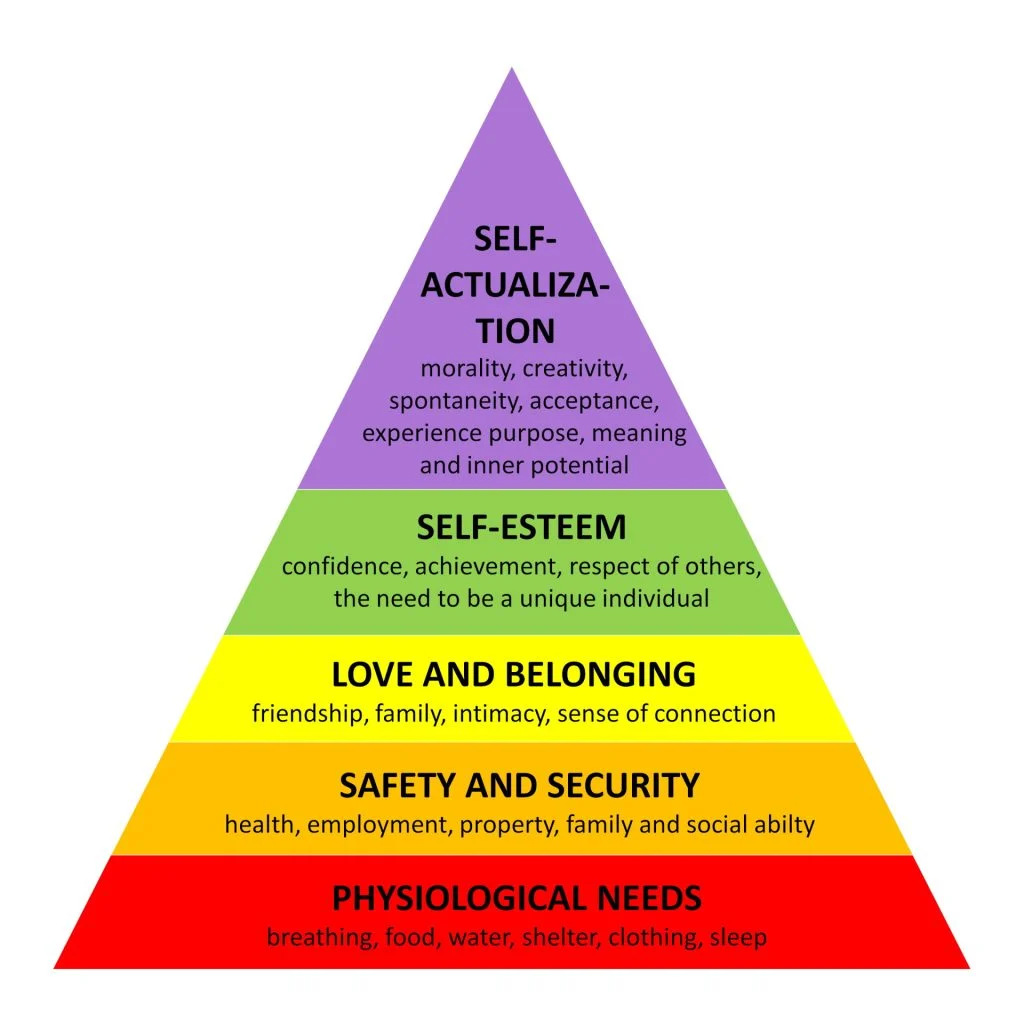
Maslow's famous hierarchy of needs is a great example of this idea. The chart
above is commonly understood to say that we must first satisfy our physiological
and safety needs before satisfying the need for relationships and spiritual
fulfillment. However, Jesus tells us that this understanding is completely
wrong:
> You act according to the particular hierarchy of needs you establish for
> yourself. Your hierarchy, in turn, depends on your perception of what you are;
> that is, what you _lack_. This establishes your own rules for what you need to
> know. Separation from God is the only lack you really need to correct. But
> your separation would never have occurred if you had not distorted your
> perception of truth, and thus perceived yourself as lacking. The concept of
> any sort of need _hierarchy_ arose because, having made this fundamental
> error, you had already fragmented yourself into levels with _different_ needs. ([CE T-1.48.22:1-6](https://acimce.app/:T-1.48.22:1-6))
In other words, every need is a distortion of our only true lack: the lack of
God. As a result of the separation, we internally disintegrated as if we
repeated the process of separating from God over and over within our own being.
At each step, we would be taken out another part of ourselves and render us more
deficient. With each new lack, we also invented a new need. We became needy
beings wanting for eveything at the same time. That is also why it seems we have
internal voices asking for too many things, some of which seem to contradict
other needs.
There is no solution to this dilemma of wanting multiple, and sometimes
conflicting things. We had to comprimise. If we wanted to satisfy the needs that
our internal voices demanded, we had to prioritize some and set others aside.
One voice may say it wants to eat right now, but another says you want to keep
looking at your phone while lying on the couch. Another voice tells you that you
would like to go out to eat, but there is also a part of you that reminds you
not to waste money and that it is better to stay home.
The idea of a hierarchy of needs seems like the most sensible thing in the
world. Without this hierarchy, we would go crazy trying to satisfy all the
internal voices asking for contradictory things. However, Jesus questions this
concept and reminds us that our only need is God.
He tells us that we have simply distorted our perception of truth when we saw
ourselves as lacking God. It is impossible to lack something that is everywhere
and is everything. Each of us is part of that everything. The belief that it is
possible to create a barrier to keep God away led us to the logical conclusion
that everyone has different needs and that certain needs are more important than
others.
Instead, we must invert the pyramid. If we could put God as our first and only
need, our behavior would unify in a way that would allow God to provide for us.
Rather than trying to satisfy all the different voices inside of us, we make
them one. A single voice. A single calling. A single need. As we will see
throught this book, this unified focus on a single thing has the power to free
us from all other wanting and also provide us with any means we need to stay in
this world for as long as it is sensible:
> Unified need produces unified action, because it produces lack of ambivalence. ([CE T-1.48.23:2](https://acimce.app/:T-1.48.23:2))
Money, then, would become for you as a secondary thing in yout life. A thing
provided for you when needed, in order to sustain your unified goal of reaching
back to God.
## Practice
If we want to gain a new vision of money and needs, we must abandon the old way
of seeing. This begins with recognizing that our current perspective is learned,
not a natural way of viewing things.
Today, we will use the technique of responding to temptation. It has two parts:
1. **Throughout the day, observe your mind and identify thoughts of need.**
For each thought of lack or need, respond slowly but without delay with the
following phrase:
> "Right now, I believe I need ----------, but my Self is truly asking for God."
For example, if you feel hunger, boredom, a need for a hug, or tiredness,
respond immediately with:
> "Right now, I believe I need -- to eat, to watch TV, a hug, to sleep --, but
> my Self is truly asking for God."
Do this with your eyes closed and spend at least half a minute slowly repeating
the phrase. Connect with the meaning of the phrase and how it makes you feel.
Continue repeating it, slowly and mindfully, until you sense an internal shift,
no matter how small. If you feel strong resistance, that is the moment to stop.
This practice does not mean you should refrain from doing anything. For
instance, it does not expect you to ignore hunger and not eat. The purpose is to
train your mind to recognize that it is not the body that asks for things, but a
deeper desire to return to your natural state.
2. **Throughout the day, observe your mind and identify thoughts of need.**
Use your phone's timer to set an alarm every 20 minutes. Each time the alarm
goes off, remind yourself of this truth:
> "God created me perfect and without lack. Let my mind be one again so I can
> return home."
Write this phrase somewhere visible so you do not forget. If repeating it every
20 minutes is too challenging, set the alarm for every 30 minutes or 1 hour. Do
not decide in advance if it is too frequent—just try it. It is okay if you
occasionally forget to repeat the phrase.
As mentioned in the previous step, it is important that you repeat the phrase
with awareness of its meaning. Do it slowly, allowing the meaning to enter your
mind. The goal is not to turn this into a mantra; we are aiming to keep the
idea's content in your mind throughout the day, not just the words themselves.
---
- [Preferred Frame Writing on GitHub.com](https://github.com/siran/writing)
(built: 2025-12-11 22:15 EST UTC-5)